You have read the rules, saved the posts, and still cannot explain why the same three habits run your mornings. A 75 day mindset challenge promises structure, but most programs hand you a checklist and call it transformation.
This article walks through how Eli Bowman's 75Mind works day by day, what the $75 covers, who the program is built for, and how its daily structure differs from other mindset challenges.
What Is Eli Bowman and the 75Mind Challenge?
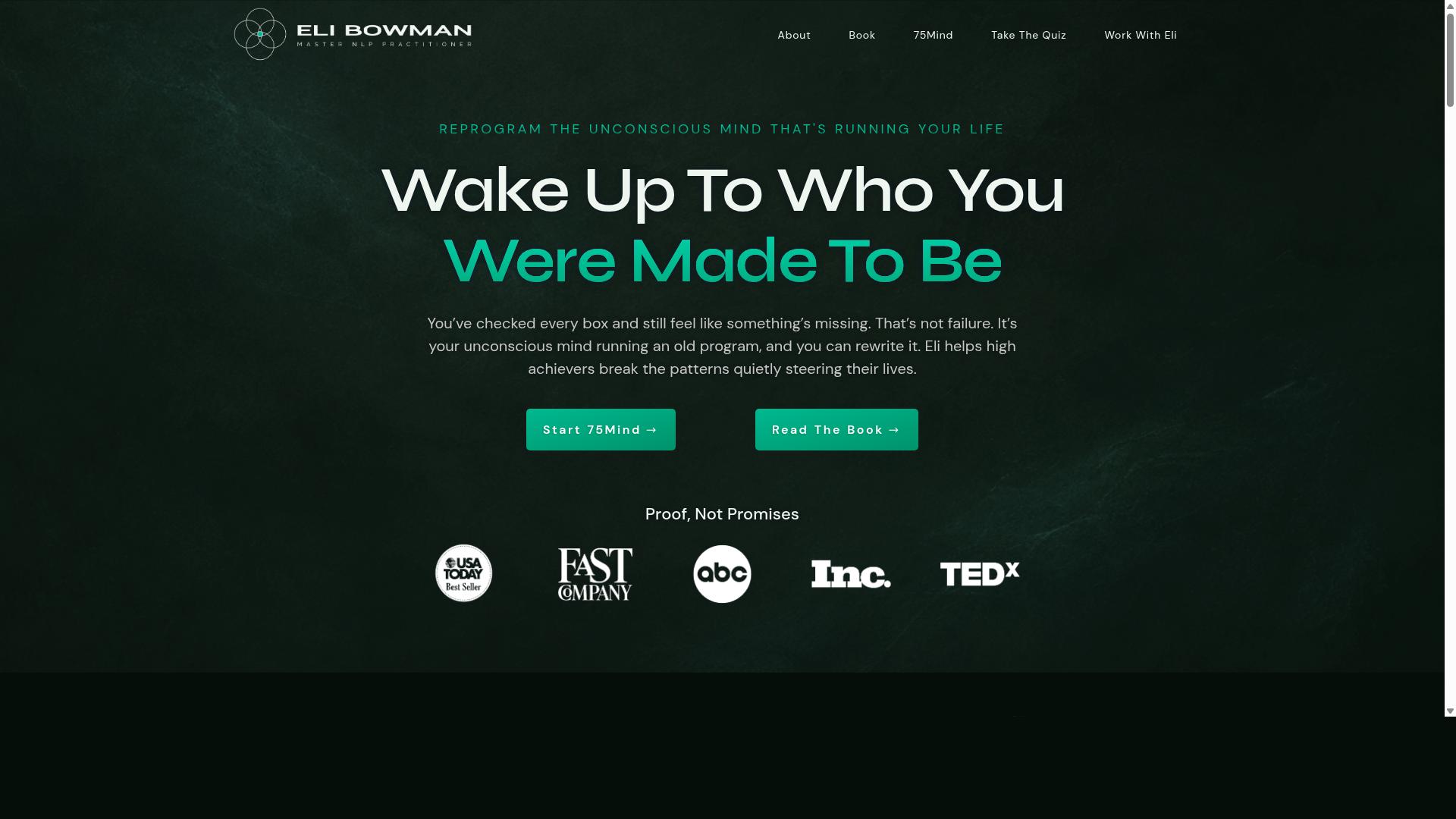
Eli Bowman and the 75Mind Challenge represent a convergence of neuroscience-based mindset coaching and a structured 75-day discipline program. Bowman is a mindset keynote speaker, author, and NLP coach who helps high achievers identify and reprogram the unconscious patterns that quietly steer their decisions.
The 75Mind Challenge is his signature program, delivered online and built around eight daily habits spread across four distinct phases. This section covers who Eli Bowman is, what credentials back his work, and what the 75Mind program actually involves.
It also explains who the challenge is designed for, so you can tell quickly whether it fits your situation. Later sections walk through the day-by-day structure, the rules, and the restart protocol in detail.
Who Eli Bowman Is: Speaker, Author, and NLP Coach
Eli Bowman is a TEDx speaker, USA Today bestselling author, and Master NLP Practitioner certified by the American Board of Neuro-Linguistic Programming. Those three credentials form the backbone of his work as a mindset keynote speaker and coach.
His central focus is the unconscious mind. Rather than treating mindset as pure motivation or willpower, Bowman approaches it as a set of learned patterns that can be surfaced and rewritten. That framing shapes everything he teaches, from stage keynotes to one-on-one coaching.
His path to this work was not a straight line. Bowman shares that he spent nearly 20 years building companies, some of which failed before the successful ones. Learning how the unconscious mind works changed his approach, and that discovery became the foundation of his coaching philosophy.
Today his work spans several formats:
- One-on-one personal coaching sessions for personalized insight into unconscious patterns
- Keynote speaking for events and organizations
- Retreats and live experiences
- His USA Today bestselling book The Program, on reprogramming the unconscious mind
- The 75Mind 75-day mindset program
The business behind these offerings is operated by Movement Maker LLC. That mix of formats matters for anyone evaluating the 75Mind Challenge: the program distills ideas Bowman has developed across two decades of entrepreneurship and a published body of work.
What 75Mind Is and Who It's Built For
75Mind is a digital program priced at $75 that guides participants through a 75-day mindset challenge designed to uncover and reprogram unconscious patterns. It is available globally online, so location is not a barrier to joining.
The structure is built on eight daily habits: tracking sleep, a morning gratitude practice, meditation or prayer, 30 minutes of intentional physical movement, at least 30 minutes of focused reading, daily social accountability, drinking 100 oz of water, and an evening journal entry. Participants also receive a participant guide PDF, a phase-by-phase roadmap, daily reflection prompts, rules and standards, and community access.
The challenge unfolds in four phases: Disruption (Days 1-18), Confrontation (Days 19-37), Rebuild (Days 38-60), and Momentum (Days 61-75). Each phase has a distinct job, which the day-by-day breakdown later in this article covers in full.
So who is it built for? The program targets high achievers who feel something is missing despite outward success. Common entry points include:
- Recurring self-sabotage that undermines clear goals
- A career or income ceiling that effort alone has not broken
- Vague restlessness that is hard to name or explain
- A search for clarity on purpose and direction
If any of those descriptions fit, the 75Mind Challenge is designed with you in mind. It is not a fitness contest or a quick detox. It is a structured mental toughness and habit formation program for people who are ready to examine why they keep repeating the same patterns, and then do something about it with consistency and accountability.
How 75Mind Works, Day by Day
The 75Mind Challenge operates on a daily structure that integrates neuroscience principles to rewire unconscious patterns over 75 consecutive days. Rather than treating transformation as a single dramatic event, the program treats it as a day-by-day discipline that compounds over time.
This section breaks down exactly how that structure functions in real life. First, it walks through what a typical day looks like in practice, then it explains the neuroscience that makes those daily actions effective.
Eli Bowman, a USA Today bestselling author, TEDx speaker, and Master NLP Practitioner, built 75Mind as a mindset-first program rather than a fitness-first one. That distinction shapes every part of the daily mechanics covered below.
What the 75-Day Structure Looks Like in Practice
In practice, the 75-day structure of 75Mind involves completing eight daily habits every day for 75 days without exception. The program is delivered through a participant guide PDF, a phase-by-phase roadmap, daily reflection prompts, and community access, with the full journey divided into four phases: Disruption (Days 1-18), Confrontation (Days 19-37), Rebuild (Days 38-60), and Momentum (Days 61-75).
The daily checklist itself covers eight tracked actions. Missing any one of them means restarting from Day 1, with zero negotiation.
- Track sleep
- Morning gratitude practice
- Meditation or prayer
- 30 minutes of intentional physical movement
- At least 30 minutes of focused reading
- Daily social accountability
- Drink 100 oz of water
- Evening journal entry
Social accountability is built into the structure for a reason. When someone else expects a check-in, skipping a task becomes a visible choice rather than a private one, which strengthens commitment and consistency.
The Neuroscience Behind the Daily Work
The daily tasks in 75Mind are designed to leverage neuroplasticity and unconscious reprogramming, drawing on principles from neuro-linguistic programming (NLP). Eli Bowman, certified as a Master NLP Practitioner by the American Board of Neuro-Linguistic Programming, emphasizes a neuroscience-based approach throughout the program.
His core premise is that 90-95% of everything you do, feel, and decide is controlled by the unconscious mind. If that estimate holds, then lasting change cannot come from willpower alone. It has to come from reprogramming the patterns running beneath conscious awareness.
This is where repetition does its work. Repeating the same eight actions daily creates predictable inputs the brain can begin to automate, gradually shifting behaviors from effortful decisions into default patterns. Over 75 days, the repetition builds new neural pathways while the old ones lose their grip through disuse.
The four phases reflect this progression deliberately. Disruption (Days 1-18) breaks existing routines, Confrontation (Days 19-37) surfaces the resistance and excuses that emerge when novelty fades, Rebuild (Days 38-60) installs the replacement patterns, and Momentum (Days 61-75) cements them as identity rather than effort.
This is also what separates 75Mind from 75 Hard, the challenge popularized by Andy Frisella. While 75 Hard is often framed around physical feats, 75Mind is mindset-first, not fitness-first, and built on NLP principles. The physical habits still matter, but they serve as vehicles for mental toughness, grit, and resilience rather than as ends in themselves.
The restart protocol reinforces the lesson at the heart of the program. Starting over after a missed habit teaches that commitment is not negotiable and that discipline is a standard rather than a mood. That lesson, repeated across 75 days, is the real transformation.
What Makes 75Mind Different From Other Mindset Challenges
Unlike other mindset challenges such as Andy Frisella's 75 Hard, 75Mind distinguishes itself through its neuroscience-based approach and emphasis on unconscious reprogramming. Where 75 Hard is built around physical execution, 75Mind is mindset-first, not fitness-first.
That single distinction reshapes everything about how the program works. The daily tasks exist to rewire how you think, not just to test whether you can endure discomfort for seventy-five days.
The architect behind this approach is Eli Bowman, a USA Today bestselling author, TEDx speaker, and Master NLP Practitioner certified by the American Board of Neuro-Linguistic Programming. His framework rests on a striking claim: 90-95% of everything you do, feel, and decide is controlled by the unconscious mind.
If that figure is even close to accurate, then most challenge programs are training the wrong 5-10%. Willpower alone cannot outmuscle an unconscious mind that is running the show. 75Mind is designed around that reality.
Fitness-First Versus Mindset-First Design
75 Hard asks participants to complete five daily tasks: two 45-minute workouts (one outdoors), a gallon of water, reading ten pages of a nonfiction book, diet adherence with no cheat meals and no alcohol, and a daily progress picture. The structure is rigorous, and its reputation for building mental toughness and grit is well earned.
But notice what those tasks measure. They measure compliance and physical endurance. They do not directly address the beliefs, internal narratives, and unconscious patterns that determine whether discipline survives after Day 75.
75Mind keeps the intensity but redirects it inward. The program is built on NLP principles, which means the daily work targets how you process information, respond to setbacks, and talk to yourself under pressure.
This is why the challenge speaks to people who have already proven they can grind. Many have finished fitness programs and still found themselves back at old habits within months. The missing piece was never effort. It was unconscious reprogramming.
Eight Daily Habits and the Zero-Negotiation Rule
Structure matters in any 75 Day Mindset Challenge, and 75Mind is no exception. The program requires completion of all eight daily habits. Miss one, and you restart from Day 1.
There is no partial credit and no negotiation. This restart protocol mirrors the accountability that makes 75 Hard effective, yet it serves a different purpose here. In a mindset-first program, the restart is not punishment. It is a live demonstration of how commitment operates when your unconscious mind starts bargaining.
That bargaining is exactly what NLP-based coaching is built to expose. Excuses like "I'll double up tomorrow" or "today doesn't count" are unconscious scripts. Completing all eight habits daily forces those scripts into the open where they can be rewritten.
Compare this to challenges that allow modified versions or flexible timelines. Flexibility feels kind, but it quietly teaches the unconscious mind that commitment is conditional. 75Mind removes that exit ramp entirely.
Why the Unconscious Mind Is the Real Target
Most self-improvement advice assumes that understanding a problem is enough to fix it. Know your bad habit, want to change, and change follows. Anyone who has broken a resolution by week two knows this model fails.
The 75Mind explanation is straightforward. If the unconscious mind drives the vast majority of behavior, then insight at the conscious level barely touches the machinery underneath. Real transformation requires working at the level where habits, identity, and automatic reactions actually live.
This is where the integration of daily tasks with mindset coaching sets 75Mind apart. The habits are not isolated boxes to check. Each one becomes a repetition that reinforces a new internal pattern, supported by coaching that helps you notice and reframe what surfaces along the way.
The day-by-day structure matters for the same reason. Habit formation and consistency build through repetition over time, not through one dramatic decision. Seventy-five days provides enough repetitions for new patterns to begin displacing old ones.
For anyone weighing which challenge fits their goals, the choice comes down to this. Choose 75 Hard for a physical gauntlet. Choose 75Mind when the pattern you most need to break lives in your head, not your schedule.
Pricing: What You Get for $75
75Mind is available for a one-time purchase of $75, which includes instant access to the full 75-day program. There is no subscription and no recurring billing. You pay once, and the entire day-by-day structure opens up immediately.
That single payment covers the core of the 75 Day Mindset Challenge experience. Instead of piecing together rules from forum posts or scattered videos, you get the program laid out in one place, ready to follow from day one through day seventy-five.
For anyone weighing the cost, the math is straightforward. Seventy-five dollars spread across seventy-five days works out to about a dollar a day for a structured daily routine built around discipline and consistency. Compared with gym memberships, coaching calls, or standalone habit apps that bill monthly, a one-time fee removes the pressure of deciding whether to renew.
What you are really paying for is structure. The program organizes the daily checklist and the day-by-day progression so you are not guessing what comes next. That clarity matters most in the middle stretch of a challenge, when motivation fades and mental toughness has to carry the load.
It helps to understand what the $75 does and does not include:
- Included: instant access to the full 75-day program after purchase
- Included: the daily structure and tasks that define each day of the challenge
- Not a subscription: this is a one-time purchase, not a recurring charge
- Separate: coaching and speaking services, which are likely custom quotes
That last point is worth clarifying. Eli Bowman's coaching and speaking work sits outside the 75Mind program and is priced separately, most likely as a custom quote based on scope. If you are only after the challenge itself, the $75 covers everything you need. If you want direct guidance beyond the program, that is a different conversation with its own pricing.
The absence of publicly listed tiers is itself informative. There is one price, one product, and one clear deliverable, which keeps the decision simple. You are not comparing packages or decoding feature grids. You either want the structured 75-day framework or you do not.
For readers evaluating whether 75Mind is worth it, the honest answer depends on how you use it. A program built around habit formation and daily follow-through only pays off if you show up. The price is low enough to remove cost as an excuse, and the one-time structure means there is no clock running on your access.
In short, $75 buys the complete 75Mind program with immediate entry, a defined daily structure, and no ongoing fees. Coaching and speaking are quoted separately, but the challenge itself stands on its own as a single, self-contained purchase.
Trust Signals: Eli Bowman's Credentials and Track Record
Eli Bowman's credentials include being a TEDx speaker, a USA Today bestselling author, and a Master NLP Practitioner certified by the American Board of Neuro-Linguistic Programming. Those three titles are not decorative. Each one points to a different skill the 75Mind program leans on: public teaching, structured writing, and applied behavioral change.
The USA Today bestselling author designation carries weight. Bestseller status reflects sustained reader demand, which is a useful proxy for whether someone's frameworks actually land with real people. Authors who sell at that level typically have spent years refining how they explain behavior change.
The NLP certification is the most directly relevant to 75Mind. Bowman emphasizes a neuroscience-based approach, stating that 90-95% of everything you do, feel, and decide is controlled by the unconscious mind. That single claim explains the program's design philosophy.
If most behavior is driven below conscious awareness, then a challenge built only on willpower is fighting the wrong battle. 75Mind is distinct from 75 Hard in that it is mindset-first, not fitness-first, and built on NLP principles. Bowman's certification is the reason that distinction holds up under scrutiny.
One point of transparency is worth stating plainly. The testimonials currently displayed on the 75Mind page are placeholder text (Lorem ipsum) and are not real customer quotes. Readers should not treat them as evidence of results.
That gap does not erase the rest of the record. A TEDx talk, a USA Today bestseller listing, and a board-certified NLP credential are all independently verifiable, and together they speak to expertise built over years rather than overnight.
For anyone weighing the 75 Day Mindset Challenge, the practical takeaway is this: judge the framework by the person who built it. Bowman's track record supports the claim that 75Mind was designed by someone who studies habit formation and mental toughness seriously, not someone repackaging a fitness trend.
The program's own structure reinforces that. It requires completion of all eight daily habits or restart from Day 1, with zero negotiation. That rule is a mindset mechanic, and it fits the credentials behind it.
Who Should Take the 75 Day Mindset Challenge
The 75 Day Mindset Challenge is designed for high achievers who feel something is missing despite checking every box in life. The resume looks right. The income, the title, the outward markers of success all line up. Yet a quiet sense that more should be possible never quite goes away.
That gap between external achievement and internal fulfillment is the exact space this work was built for. Eli Bowman's target audience is not people who need a rescue plan. It is people who have already proven they can perform, and now want their inner life to match their outer results.
If any of the following descriptions sound familiar, this challenge was likely built with you in mind:
- High achievers with a nagging sense of emptiness. You have hit milestones that once felt impossible, and the satisfaction faded faster than expected.
- People stuck in self-sabotage loops. You know what to do, you start strong, and then something inside quietly pulls you off course.
- Anyone hitting a career or income ceiling. Effort alone stopped moving the needle, and the missing piece seems to be internal rather than tactical.
- Those with vague restlessness. Nothing is technically wrong, but you cannot shake the feeling that you are meant for something you have not named yet.
- People seeking clarity on purpose. You want a defined direction, not another motivational quote.
Each of these pain points shares a common root: a mindset that was never rebuilt to match the level of success a person is chasing. The 75 Day Mindset Challenge addresses that root directly rather than treating symptoms.
Self-sabotage, for example, is rarely a discipline problem in high achievers. It is usually an identity problem. The program's day-by-day structure forces daily choices that gradually align behavior with a new self-image.
Career and income ceilings work similarly. When effort has plateaued, the constraint is often internal, whether that is fear of visibility, discomfort with asking, or an unexamined belief about what is possible. A structured daily routine surfaces those patterns because they show up in the small decisions, not in grand moments.
Vague restlessness and the search for purpose respond to consistency over time. Clarity tends to arrive after action, not before it. Seventy-five days of repeated commitment creates the conditions for that clarity to emerge.
The program also serves organizations. Eli Bowman works with teams through speaking engagements and retreats, bringing this mindset work to groups that want their people operating at a higher level. Leaders who recognize these patterns in their teams can use that format to address them collectively.
It is worth being direct about who this is not for. Anyone looking for a passive experience, a quick fix, or a program that does the work on their behalf will be disappointed. The challenge asks for real commitment across 75 days, and the results follow that commitment.
For the right person, though, the fit is close to exact. If you have achieved a lot and still sense untapped capacity, if your patterns keep undercutting your effort, or if you simply want to know what you are actually aiming at, this challenge was designed with your situation in mind.
Final Verdict: Is 75Mind Worth It?
After examining the 75Mind Challenge, it's clear that it offers a unique neuroscience-based approach to mindset transformation for those willing to commit to 75 days of discipline. The $75 investment buys more than a checklist. It buys a structured system designed to rewire how you think, not just what you do.
Unlike the original 75 Hard, which leans heavily on physical tasks, 75Mind places mental toughness and habit formation at the center of the experience. The daily structure still demands consistency, but the emphasis falls on the internal work that drives lasting change.
Here is what the $75 covers at a glance:
- Structured daily tasks delivered through a day-by-day format
- Neuroscience-based methods aimed at breaking unconscious patterns
- A clear framework for accountability and follow-through across 75 days
For someone ready to confront the routines and thought loops holding them back, that structure can be genuinely valuable. The challenge does not promise overnight transformation. It asks for 75 days of sustained effort, and the payoff scales with that commitment.
Who gets the most from it? People who have tried generic self-improvement advice and found it too loose to stick. The day-by-day design removes guesswork. Each day tells you what to do, which reduces reliance on motivation and builds discipline and resilience instead.
It is fair to note the challenge is not for everyone. If you want a passive course you can skim once, this is not that. The value only materializes through daily participation, which is precisely the point of a mindset challenge built around consistency.
On the practical side, Eli Bowman's site does not list a physical address, phone number, or email. Instead, you can reach out through the contact form on the website. Social media profiles on Instagram, Facebook, YouTube, and LinkedIn are also available for updates and questions. Copyright is held by Movement Maker LLC.
So is 75Mind worth the $75? For anyone serious about breaking unconscious patterns and building real mental grit, the answer is a confident yes. The combination of daily structure, a neuroscience-informed method, and a defined 75-day arc gives you a framework you can act on immediately.
If you are on the fence, start with the free 2-minute quiz on the website. It will help you see whether this challenge fits where you are right now. Then visit the site to learn more and decide if you are ready to commit to the full 75 days.
Frequently Asked Questions
What exactly is the 75 Day Mindset Challenge, and how does 75Mind work day by day?
The 75 Day Mindset Challenge is a structured, day-by-day program delivered through 75Mind, built around Eli Bowman's neuroscience-based approach to reprogramming the unconscious mind. Rather than just stacking habits, it walks you through daily mindset work designed to surface and shift the hidden patterns that quietly steer your behavior. You get instant access after purchase, so you can start the first day right away.
How much does 75Mind cost, and is it a subscription?
75Mind is a one-time purchase of $75 with instant access - there's no subscription or recurring fee. Once you buy it, the full 75-day program is yours to work through at your own pace. If you're looking for personalized coaching or want Eli Bowman to speak at your event, those are arranged separately.
Who is the 75 Day Mindset Challenge designed for?
It's built for high achievers who feel something is missing even though they've checked every box - people dealing with self-sabotage, career or income ceilings, or a vague restlessness they can't quite name. If you're seeking clarity on purpose and want to address the unconscious programming underneath those patterns, this is designed with you in mind. Eli Bowman's work specifically targets the 90-95% of mental activity that operates below conscious awareness.
Who is Eli Bowman, and what makes his approach different?
Eli Bowman is a mindset keynote speaker, author, and NLP coach - a TEDx speaker, USA Today bestselling author of The Program, and a Master NLP Practitioner certified by the American Board of Neuro-Linguistic Programming. His approach is neuroscience-based, focusing on reprogramming the unconscious mind rather than relying on willpower alone. That same philosophy runs through the 75 Day Mindset Challenge.
Do I need any prior experience with NLP or mindset work to start?
No. The 75 Day Mindset Challenge is structured as a day-by-day process, so you're guided step by step rather than expected to arrive with prior training. It's accessible worldwide online, so you can work through it from anywhere. If you want deeper, personalized insight into your own unconscious patterns, Eli Bowman also offers one-on-one coaching.
Can I try something before committing to the full 75 days?
Yes - the site offers a free 2-minute quiz to help you uncover your unconscious programming, which is a useful first step before diving in. It gives you a sense of the patterns Eli Bowman's work targets without any commitment. From there, you can decide whether the full 75 Day Mindset Challenge fits where you are right now.
Recommended Resources: