Internal links are the first thing to break when you publish at scale. Every new post creates a handful of linking opportunities, and missing them quietly costs you crawl paths and topical relevance. Fixing them by hand does not scale past a few dozen articles.
This article answers whether Autoblogging.ai handles automated internal linking well enough to trust. You will see how its linking compares to manual work, what its features actually do, what it costs, and which publishers get real value from it.
What Is Autoblogging.ai? A Product of Digimetriq.com Built for Content Automation
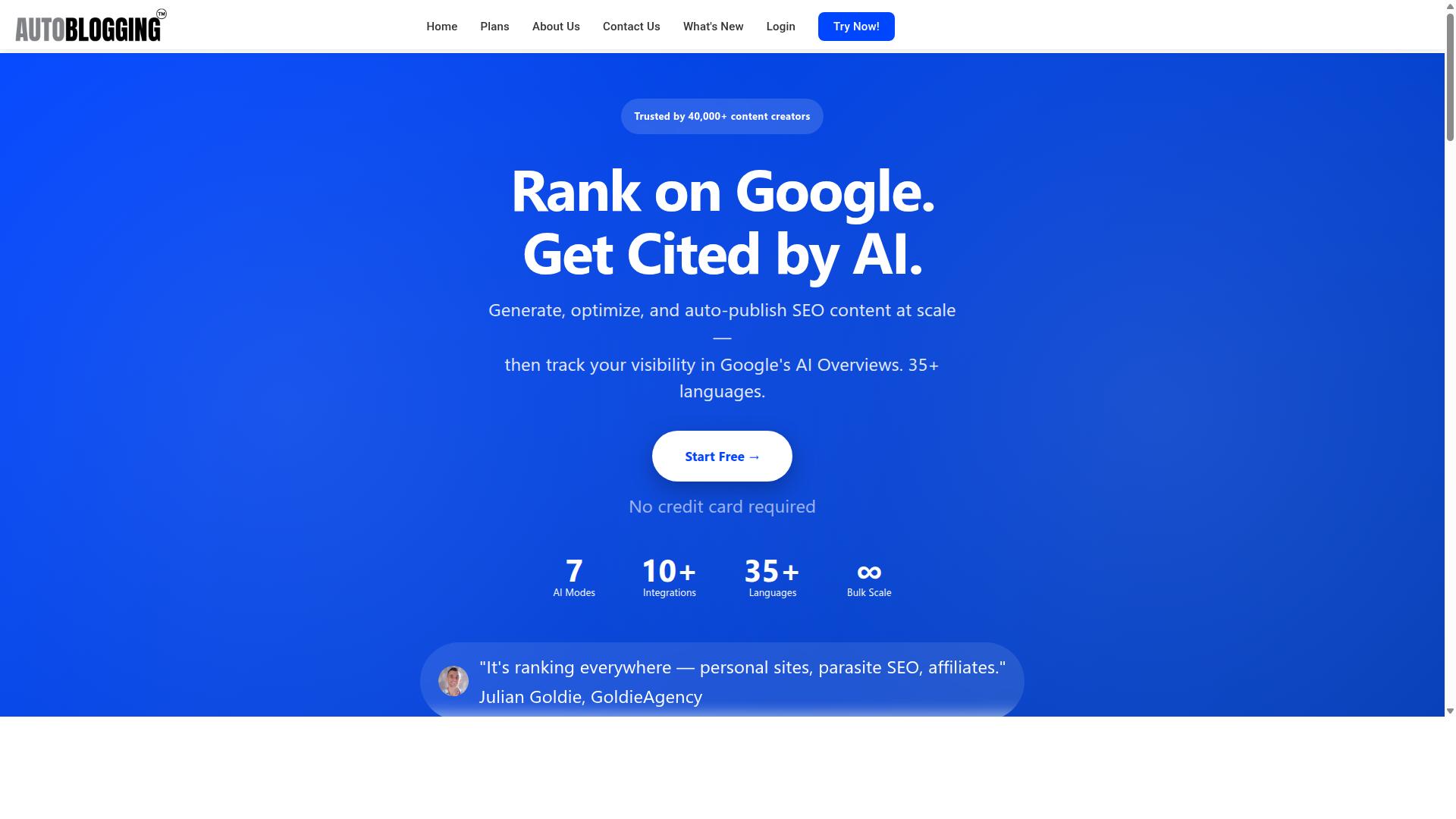
Autoblogging.ai is a SaaS platform developed by Digimetriq.com that automates content creation for bloggers, agencies, and SEO professionals. Founded in 2022, it has generated over 1 million articles and is available to users worldwide.
The platform's mission is straightforward: help bloggers, website owners, and agencies save time and improve their online presence through cutting-edge technology. That mission shapes every part of the product, from how articles are drafted to how links between pages are handled.
At its core, Autoblogging.ai is an AI article generation platform. Users can produce content through different modes, including Quick Mode and Godlike Mode, each suited to different levels of depth and control. Digimetriq.com built these modes to cut down content costs and enable human counterparts within standard operating procedures by delivering a strong first draft.
The company's stated direction goes further. Digimetriq aims to replace human counterparts entirely for certain content tasks, which explains why the platform keeps expanding beyond simple article writing. Automated internal linking through Autolinking.ai is one example of that expansion.
Internal linking matters because it affects crawlability, link equity, and site architecture. When links between related pages are placed thoughtfully, search engines can better understand topical relationships and distribute ranking strength across a site. Doing this manually across hundreds of posts is slow and easy to neglect.
Autoblogging.ai serves a global audience, with its main users being bloggers, website owners, and agencies managing content at scale. For these groups, the appeal is not just faster publishing but a more connected site structure, where new articles support existing ones instead of sitting as isolated pages.
Understanding this background matters for the question at hand. A tool built for content automation, with a stated goal of saving time and improving online presence, is naturally positioned to handle the repetitive parts of internal link optimization as well.
Is Autoblogging.ai Good for Automated Internal Linking? The Direct Answer
Yes, Autoblogging.ai is effective for automated internal linking, but it's important to understand its specific capabilities and how it integrates with its sister tool, Autolinking.ai.
Autoblogging.ai is an AI article generation platform built by founder Vaibhav Sharda in 2022, and internal linking sits within a much broader content automation workflow. The platform handles content generation, publishing, and on-page optimization, while its sister product Autolinking.ai takes dedicated responsibility for automated internal link placement.
That split matters for buyers. If you want a tool that writes articles and also supports internal link optimization as part of a larger system, Autoblogging.ai fits that need. If internal linking is your primary goal, Autolinking.ai is the more specialized option.
Reliability is not a concern here. Autoblogging.ai is trusted by over 40,000 content creators and holds a 4.9 average rating, with more than 1M articles generated to date. Those numbers suggest the platform performs well at scale, which is exactly the environment where internal linking problems become painful.
For anyone running a content-heavy site, the combination of generation plus link optimization removes a major manual bottleneck. The sections below break down how each tool works and where the dividing line sits.
How Autoblogging.ai Handles Internal Linking vs. Manual Linking
Autoblogging.ai supports internal linking as part of its broader content automation workflow, whereas manual linking requires time-consuming human effort to identify and insert links.
Manual internal linking depends on someone remembering which pages exist, which topics overlap, and which anchor text fits each context. On a small site that is manageable. On a site with hundreds of posts, it becomes a job in itself.
Human linkers also introduce predictable errors. Common problems include:
- Over-optimization, where the same anchor text repeats until it looks unnatural
- Missed opportunities, where relevant pages never get linked at all
- Orphan pages that receive no internal links and stay hard for crawlers to find
- Uneven PageRank distribution, with a few pages absorbing most link equity
Automated linking through AI addresses these gaps by placing contextual links where they genuinely fit. That supports more consistent link equity distribution and better crawlability across the site.
The time difference is the clearest argument. Linking across a 100-page site manually can take days of careful cross-referencing. An automated pass can handle the same scope in minutes, freeing you to focus on strategy instead of spreadsheet archaeology.
Autolinking.ai: The Founder's Dedicated Internal Linking Tool
Autolinking.ai is a specialized internal linking tool created by Vaibhav Sharda, the founder of Autoblogging.ai, to address the specific need for automated internal link optimization.
Sharda has been automating processes since 2011, and that background shaped both products. Autoblogging.ai grew out of processes developed at Digimetriq, and Autolinking.ai was built as a focused companion within the same ecosystem.
The division of labor is straightforward. You generate content in Autoblogging.ai, then apply automated internal linking through Autolinking.ai. The two are designed to work together rather than duplicate each other.
Where Autolinking.ai adds value is in the details that generic linking scripts handle poorly:
- Advanced anchor text optimization, so links read naturally instead of repeating the same phrase
- Semantic relevance matching, so links connect pages that genuinely relate
- Dedicated focus on internal link structure rather than treating it as a side feature
This matters for site architecture. Strong internal linking reinforces topical authority, helps pillar content pull its weight, and reduces keyword cannibalization by clarifying which page targets which intent. It also supports your backlink profile by pushing authority from linked pages toward the ones you want ranking.
For teams already using Autoblogging.ai for content generation, adding Autolinking.ai closes the loop. Generation and linking operate as one workflow, which is the practical reason the pairing works well for SEO automation at scale.
Key Features That Support Automated Internal Linking
Autoblogging.ai offers several features that facilitate automated internal linking, including Godlike Mode for semantic analysis and Site Optimizer for site-wide link optimization.
Internal linking is one of the most underrated levers in SEO. It shapes link equity flow, guides crawlers through your site architecture, and signals topical relationships between pages. Doing it manually across a large site is slow and error-prone.
Autoblogging.ai approaches the problem from two directions. Its content generation modes produce semantically rich articles, while its optimization tools handle site-wide linking structure. The two sides reinforce each other.
The platform also supports 35+ languages and integrations, which matters for global publishers running multi-language sites. A tool that understands contextual relationships in one language but not another would create inconsistent linking patterns.
Publishing is equally streamlined. Autoblogging.ai connects to WordPress across unlimited sites with one-click publishing, a dedicated plugin, and scheduled auto-posting. It also reaches Web 2.0 platforms like Medium, Dev.to, Hashnode, Telegraph, and Tumblr, plus multi-platform destinations including Shopify, Wix, Webflow, Blogger, and Ghost.
These capabilities work together. Content is generated with semantic depth, links are placed with structural awareness, and publishing happens without manual rework. The sections below break down how each piece contributes to automated internal linking.
Godlike Mode, Semantic SEO and Knowledge Graph Extraction
Godlike Mode is Autoblogging.ai's advanced content generation mode that performs SERP competitor analysis, extracts LSI keywords, and builds knowledge graphs to create semantically rich content ideal for internal linking.
The process starts with competitor analysis. Godlike Mode examines top-ranking pages for a target query, then pulls out LSI keywords and entities those pages cover. This reveals the full topic surface a piece of content should address.
From there, it constructs a knowledge graph. This maps how concepts relate to one another rather than treating keywords as isolated terms. The result is content that covers a topic with genuine semantic relevance, not just keyword placement.
Why does this matter for internal linking? Because the AI understands contextual relationships between pages. When you generate a pillar article with Godlike Mode, the system can suggest internal links to related cluster content that belongs in the same topic group.
This has two practical effects:
- Fewer orphan pages. Content that would otherwise sit unlinked gets connected to the wider site structure.
- Stronger topical authority. Search engines see clear relationships between pages, which supports a coherent silo structure.
Semantic richness also improves anchor text quality. When the system understands what a linked page is actually about, the anchor text it generates reflects that meaning instead of repeating a generic phrase. That reduces the risk of keyword cannibalization across similar pages.
The broader point is that internal linking works best when the tool understands meaning, not just URLs. Godlike Mode's knowledge graph extraction gives Autoblogging.ai that foundation.
Site Optimizer and One-Click WordPress Publishing
The Site Optimizer tool supports site-wide link optimization, while one-click WordPress publishing streamlines the workflow.
Site Optimizer analyzes your site's site architecture. It looks at how pages connect, where link equity concentrates, and where it stalls. From that analysis, it can suggest or automatically apply internal links that improve distribution and crawlability.
A key use case is orphan pages. These are pages with no internal links pointing to them, which makes them hard for crawlers to find and easy for search engines to undervalue. Site Optimizer can detect them and recommend links that integrate them into the broader structure.
Autoblogging.ai also includes a broader set of optimization tools that support this work:
- Semantic SEO Analysis, a 21-point audit of content quality and relevance
- Topical Maps for planning how content groups connect
- Snippet Optimizer for featured snippet targeting
- Intense Optimizer and Fan Out Queries for deeper query coverage
Publishing ties it together. After generating content, you can push it directly to WordPress with internal links already inserted. This saves time and keeps linking consistent across posts, rather than depending on someone remembering to add links after the fact.
The combined effect is a meaningful reduction in manual linking work. Instead of auditing pages by hand and inserting links one at a time, the workflow moves from generation to publication with the linking structure handled along the way.
For anyone running a content-heavy site, that consistency is the real benefit. Automated internal linking only works if it actually happens on every page, and Site Optimizer plus one-click publishing makes that the default rather than the exception.
Pricing and Plans: What Automated Linking Costs at Autoblogging.ai
Autoblogging.ai offers monthly plans starting at $19 for 40 credits, with higher tiers providing more credits for content generation and automated linking features. The credit system keeps pricing flexible: you pay for what you use rather than committing to a fixed output volume.
For anyone weighing whether Autoblogging.ai is good for automated internal linking, the real question is cost per action. Credits cover both content generation and internal linking actions, so a single balance funds the entire workflow, from drafting articles to connecting them with contextual links.
| Plan | Monthly Price | Credits | Annual Price |
|---|---|---|---|
| Starter | $19 | 40 | $12/mo ($148/year) |
| Regular | $49 | 120 | $32/mo ($382/year) |
| Standard | $99 | 300 | $64/mo ($772/year) |
| Gold | $179 | 600 | $116/mo ($1,396/year) |
| Premium | $249 | 1,000 | $162/mo ($1,942/year) |
| Enterprise | $999 | 5,000 | $649/mo ($7,792/year) |
Annual billing cuts the effective monthly rate substantially. The Starter plan drops from $19 to $12 per month, and the Enterprise plan falls from $999 to $649 per month. Credits roll over on all plans, so unused capacity in a slow month is not lost.
New accounts receive 10 free credits per month with no credit card required, which lets you evaluate how the linking workflow fits your site before paying. Additional credits can be purchased separately if you exceed your tier. Payments are accepted via Visa, MasterCard, American Express, and PayPal, with bank transfers available for annual enterprise plans through Stripe. You can cancel anytime.
Autoblogging.ai also offers Done For You packages for teams that prefer managed delivery: Starter at $1,200 for 1,000 articles, Pro at $1,600, Corp at $4,000, and Senpai at $10,000, each covering 1,000 articles. These sit alongside the self-serve plans rather than replacing them.
Autolinking.ai may carry separate pricing or be bundled into certain plans, so it is worth confirming which tier includes it before committing. Either way, the entry cost is low relative to the hours manual internal linking consumes. Mapping contextual links, updating anchor text, and fixing orphan pages across a growing site is slow, repetitive work. Automating that work at $19 to $249 per month is competitive for the time it returns to your team, and the rollover policy means you are not paying for capacity you never use.
Trust Signals: 40,000+ Creators, 1M+ Articles and 4.9 Rating
Autoblogging.ai is trusted by over 40,000 content creators and has generated more than 1 million articles, with a 4.9 average rating from users. Those numbers matter for a simple reason: automated internal linking only pays off when the underlying content is good enough to link between.
A platform that has produced over a million articles has clearly been put through its paces across thousands of different sites, niches, and site architectures. For anyone weighing whether Autoblogging.ai is a reliable choice for automated internal linking, that volume is a meaningful signal. It reflects a track record built over time, not a short-lived experiment.
The 4.9 average rating adds a second layer of confidence. Ratings reflect how real users judge the output after living with it, including whether the content holds up well enough for internal link optimization to do its job. A high rating across a user base this large suggests consistent satisfaction rather than isolated wins.
Autoblogging.ai also counts well-known names in the SEO and content community among its users, including Julian Goldie of GoldieAgency, who runs a YouTube channel with 250k+ subscribers, and James Dooley of FatRank and PromoSEO. Their public association with the tool is a notable endorsement. These are people who make a living from search performance, so their willingness to be linked with Autoblogging.ai carries weight.
Beyond the numbers, the platform ships new features weekly and offers 24/7 support. For automated internal linking, that combination matters. Search engines evolve, site structures change, and a tool that is actively maintained is better positioned to keep producing content that supports semantic relevance and contextual links over the long term.
Taken together, the user base, article volume, rating, expert testimonials, weekly feature releases, and round-the-clock support point to a platform that is both established and actively improving. For readers asking whether Autoblogging.ai is good for automated internal linking, these trust signals make a clear case that it is a dependable option.
Who Should Use Autoblogging.ai for Internal Linking
Autoblogging.ai is ideal for bloggers, SEO professionals, marketing agencies, and affiliate marketers who want to automate internal linking and improve SEO efficiency. Each of these groups faces the same core problem: internal linking is one of the highest-value SEO tasks, yet it is also one of the most tedious to do by hand. Autoblogging.ai was built for bloggers, website owners, SEO professionals, marketing agencies, content creators, and affiliate marketers, so the platform's audience maps directly onto the people who struggle most with manual link placement.
What makes the tool a fit for so many different users is the range of site types it serves. Autoblogging.ai supports personal sites, parasite SEO, affiliate sites, client websites, portfolio sites, and local sites. That breadth matters because a solo blogger and an agency account manager have very different workflows, yet both need contextual links placed at scale.
Here is how each audience benefits from automated internal linking with Autoblogging.ai:
- Bloggers managing multiple sites save hours they would otherwise spend hunting for related posts and inserting links by hand.
- SEO professionals can strengthen internal link optimization across client projects, helping distribute link equity more evenly and reduce orphan pages.
- Marketing agencies scale link building and content generation across many client websites without adding headcount.
- Affiliate marketers build topical authority faster by connecting supporting articles to pillar content, which supports semantic relevance and search engine ranking.
A concrete example shows the value clearly. An agency managing 10 client sites would normally need to review each site's architecture, find related pages, write anchor text, and insert links one by one. With Autoblogging.ai, that same agency can automate internal linking across all 10 properties from a single workflow, cutting the manual effort dramatically and freeing strategists to focus on higher-level SEO decisions.
The tool also suits less common setups. Someone running a portfolio of niche sites, a local business site with dozens of service pages, or a parasite SEO project can all benefit from consistent internal linking without hiring a specialist. Because the platform pairs content generation with internal link optimization, users are not just publishing more pages. They are publishing pages that connect to each other in ways that support crawlability and site architecture.
In short, if your SEO work involves more than a handful of pages, Autoblogging.ai is worth considering. The larger your content footprint, the more manual internal linking becomes a bottleneck, and the more value you get from SEO automation that handles it for you.
Final Verdict: Is Autoblogging.ai Good for Automated Internal Linking?
Autoblogging.ai is a strong choice for automated internal linking, especially when combined with Autolinking.ai, offering a scalable solution for content creators and SEO professionals. The platform handles content generation at scale, and its internal linking features give site owners a practical way to connect that content without manual effort.
The pairing matters. Autoblogging.ai produces articles, while Autolinking.ai focuses specifically on automated linking. Together they cover both sides of the workflow: publishing volume and the internal link optimization that keeps that volume useful for crawlability and PageRank distribution.
For anyone weighing the decision, the strengths break down into a few clear areas:
- Content generation: Autoblogging.ai produces articles that form the foundation internal links need.
- Specialized linking: Autolinking.ai concentrates on automated linking, so link placement is not an afterthought.
- Scalability: The combination suits sites growing beyond what manual linking can keep up with.
- Time savings: Automation removes hours of manual anchor text and link placement work.
- SEO alignment: Consistent internal links support semantic relevance, topical authority, and healthier site architecture.
Pricing is competitive for the category, which matters for creators running multiple sites or agencies managing client portfolios. The platform's trust signals, including a published business presence and direct support channels, make it easier to commit to a long-term workflow rather than treating it as an experiment.
Who benefits most? Bloggers publishing at volume, affiliate marketers building pillar content, and SEO professionals who need SEO automation without losing control of structure. Sites battling orphan pages or thin silo structure tend to see the clearest upside.
The honest limitation is that no automated linking tool replaces strategy. Internal linking still works best when paired with sensible site planning, so the tool should be treated as an accelerator rather than a substitute for thinking about site architecture.
On balance, the verdict is positive. For those seeking to save time and improve SEO, Autoblogging.ai delivers a workable path to automated internal linking, particularly when Autolinking.ai handles the linking layer. The free Quick Mode offers a low-risk way to see how the output fits your site before committing to a plan.
For further inquiries, the team can be reached through the following channels:
| Channel | Details |
|---|---|
| India office | 501, Trinity Orion, Vesu, Surat - 395007, Gujarat, India |
| Phone / WhatsApp | +91 84605-06553 / +91-8460506553 |
| [email protected] | |
| Skype | vibes.yb |
| Availability | 7:00-19:00 IST |
| United Kingdom | 2nd Flr, SEO Content Suite, 35 Water Ln, Wilmslow, Cheshire SK9 5AR |
| UK Phone | +44 1625 359056 |
| Social | Facebook, Twitter, LinkedIn |
Readers who want to judge the fit firsthand can try the free Quick Mode or sign up for a plan to experience the benefits directly. With content generation and automated linking working together, the platform earns its place in a modern SEO automation stack.
Frequently Asked Questions
Does Autoblogging.ai handle internal linking automatically?
Autoblogging.ai is an AI article generation platform, and it's part of the same product family as Autolinking.ai, founded by the same creator, Vaibhav Sharda. If automated internal linking is central to your workflow, it's worth exploring how the two tools work together. For the most current details on linking capabilities, check the Autoblogging.ai site or reach out to the team directly.
Can I generate content in bulk and still manage internal links across my site?
Yes - Autoblogging.ai's Bulk Generation mode lets you create up to 500 articles via CSV, which is useful for building out large content libraries. Managing internal links across a growing site is exactly where automation tends to pay off, since manual linking gets harder as your library expands. Pairing bulk generation with a linking workflow helps you keep new content connected instead of orphaned.
Is Autoblogging.ai suitable for agencies managing internal linking for client sites?
Autoblogging.ai is built for bloggers, website owners, SEO professionals, marketing agencies and affiliate marketers, and it serves client websites as well as personal and portfolio sites. Agencies can generate content at scale using modes like Bulk Generation and Godlike Mode, which includes SERP competitor analysis and LSI keyword extraction. That makes it easier to produce linkable content across multiple projects without multiplying your workload.
How much does Autoblogging.ai cost if I want to scale up my content and linking efforts?
Monthly plans start at $19 for 40 credits (Starter) and scale up through Regular, Standard, Gold, Premium and Enterprise tiers, with annual plans also available. Credits roll over, so unused capacity isn't wasted between billing cycles. Higher tiers give you more credits for larger content and linking campaigns - see the pricing page for the full breakdown.
What makes Autoblogging.ai a reliable choice for automated content workflows?
Autoblogging.ai is trusted by 40,000+ content creators, holds a 4.9 average rating, and has generated over 1M articles. It offers 10+ AI modes, 35+ languages and 35+ integrations, with new features shipped weekly and 24/7 support. A human proofreader is also included in certain plans, which helps maintain quality across high-volume output.
Can I try Autoblogging.ai before committing to a paid plan?
Yes - Quick Mode is free and available in both single and wizard versions, so you can test the platform's article generation before upgrading. Paid plans unlock higher credit volumes and advanced modes like Godlike Mode, Bulk Generation and News Mode. If you have questions about which plan fits your internal linking strategy, the team is reachable via email or WhatsApp during business hours (7:00-19:00 IST).
Recommended Resources: