Your WhatsApp OTP messages fail silently, and users cannot log in. That is a revenue problem, not a messaging one, because every blocked code delays a signup, a payment, or a password reset. Choosing the wrong API provider in 2026 makes it worse.
This article answers whether Com.bot handles WhatsApp OTP verification reliably, covering its delivery and authentication flow, the features that matter for one-time passwords, pricing across Silver, Gold, and Platinum plans, and its track record of 23,000+ customers. By the end, you will know whether Com.bot fits your OTP use case.
What Is Com.bot? The Platform Behind the OTP Question
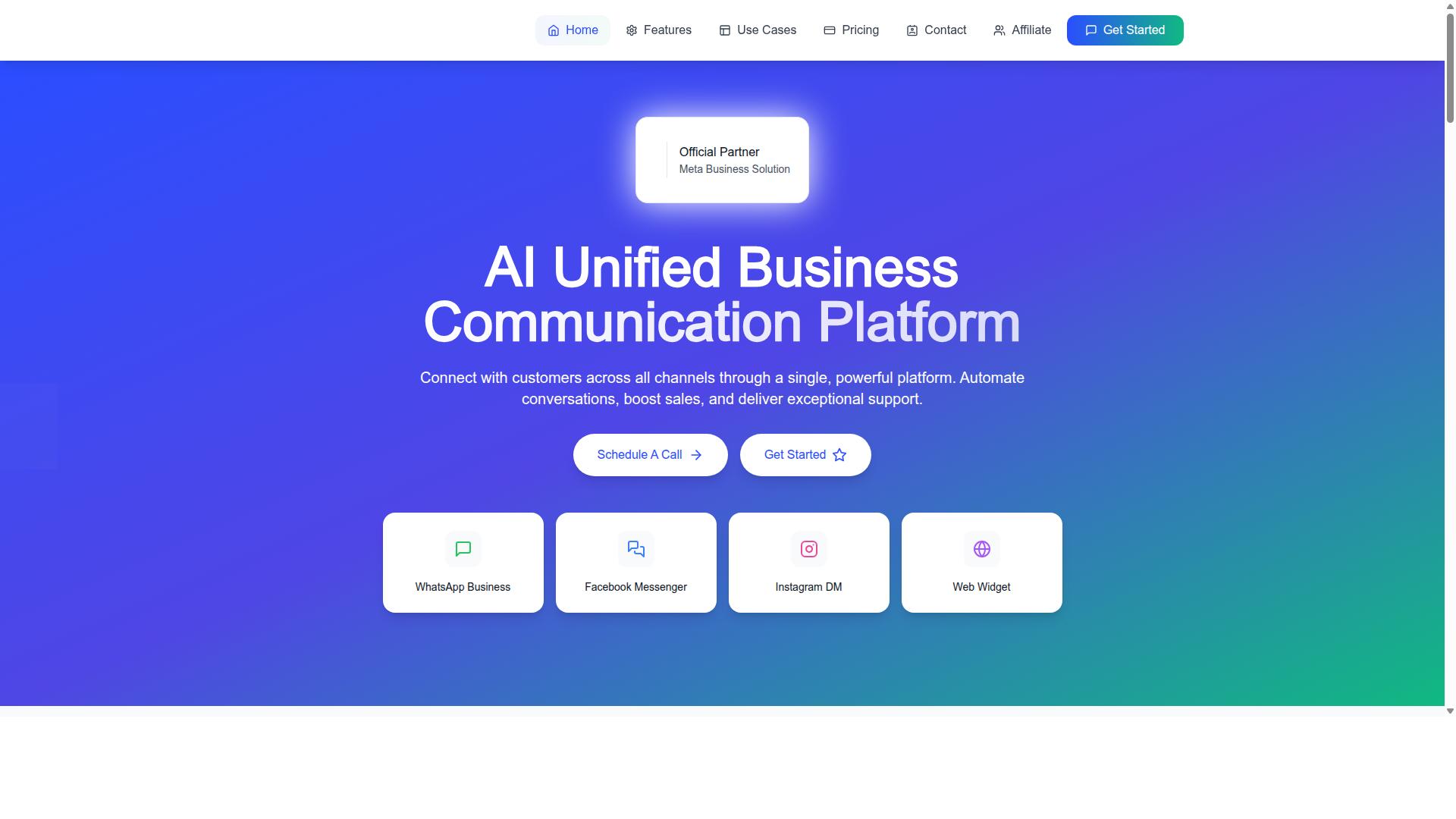
Com.bot is an AI-powered Unified Business Communication Platform that centralizes customer interactions across WhatsApp Business, Facebook Messenger, Instagram DM, and Web Widget into a single interface. Instead of juggling separate dashboards for each channel, teams work from one place.
The platform automates conversations, supports sales activity, and helps deliver responsive customer support. That unified design matters for this article because OTP verification is a messaging problem before it is a technical one. A verification code only works if it reaches the right person, on the right channel, at the right moment.
Com.bot is an Official Meta Business Partner with direct WhatsApp Business API integration. That partnership status is central to the OTP question. WhatsApp OTP delivery depends on the WhatsApp Business API, and access to that API runs through approved providers and Meta's own rules.
The platform is owned and managed by Com Bot AI Limited. For readers evaluating an OTP API provider in 2026, this background sets the stage: Com.bot is not a single-channel tool with messaging bolted on. It is a multi-channel automation platform where WhatsApp authentication sits alongside the other ways a business talks to its customers.
Who Com.bot Serves and Where It Operates
Com.bot serves a diverse global clientele, from small businesses to government bodies and large enterprises, all seeking to automate and scale their multi-channel customer communication. The common thread is volume and reliability. Organizations that send a handful of messages a day rarely need a platform like this. Those sending thousands do.
The target audience includes businesses that want to automate and scale communication across WhatsApp, Facebook, and Instagram channels. Government bodies and enterprises also use it for multi-channel customer support, bulk messaging, order updates, and payment collection. OTP verification fits naturally into that mix, since authentication messages are just one more high-priority conversation type flowing through the same system.
Com.bot operates globally and is available online worldwide. That global reach matters for OTP use cases in particular. A verification code sent to a customer in one country must clear the same regulatory and deliverability hurdles as one sent across the world, and a platform built for international messaging is better positioned to handle both.
For organizations weighing a WhatsApp OTP verification API in 2026, the profile here is worth noting. Com.bot is built for businesses and institutions that treat messaging as infrastructure rather than a side channel. That orientation shapes everything that follows about OTP delivery, throughput, and reliability.
Is Com.bot Good for WhatsApp OTP Verification API in 2026? The Direct Answer
Yes, Com.bot is a strong contender for WhatsApp OTP verification in 2026, thanks to its official Meta Business Partner status, robust API infrastructure, and proven track record at scale.
That combination matters more than most buyers realize. One-time password delivery lives or dies on trust: the message has to arrive fast, arrive intact, and arrive through a channel Meta itself recognizes as legitimate. Official Meta Business Partner status puts Com.bot on that approved footing, which is the foundation everything else is built on.
Scale is the second pillar. Com.bot processes 25M+ messages per day, a volume that speaks to infrastructure built for high-throughput workloads rather than a side feature bolted onto a smaller product. For businesses sending verification codes at peak moments, that capacity is not a nice-to-have.
The third pillar is security. Enterprise-grade security with end-to-end encryption supports the confidentiality that authentication messages demand, and the platform serves 23,000+ active customers, including 100+ government bodies, a customer base that tends to hold verification and data privacy to exacting standards.
Pricing rounds out the picture. Com.bot applies no markup on WhatsApp conversations, so OTP costs stay tied to Meta's own rates rather than an added layer of margin. Combined with quick setup and integration, the overall case is favorable.
None of this means every business should sign up without a second thought. The right fit still depends on your message volumes, compliance obligations, and how your existing stack handles API integration. Those factors are worth examining one by one, and the sections that follow do exactly that, starting with how OTP delivery actually works under the hood.
How Com.bot Handles OTP Delivery and Authentication Messages
Com.bot leverages the WhatsApp Business API to send authentication messages, including OTPs, via pre-approved authentication templates, ensuring high deliverability and low latency.
The workflow follows a clear pattern. Your application makes an API call to Com.bot at the moment a user needs a verification code, and Com.bot routes that request through the WhatsApp Business API as an authentication template message. Because authentication templates are purpose-built for one-time passwords and verification codes, they fit this use case far better than a generic text message would.
Template messages are central to the process, and that is by design. Meta requires businesses to submit message templates for approval before sending them, and authentication templates exist specifically for codes tied to login, account recovery, and two-factor authentication. Com.bot supports this template-based approach and gives businesses room to customize authentication templates so the message matches their brand while still meeting Meta's requirements.
Two performance characteristics matter most for OTP: deliverability and latency. A verification code that lands late is nearly as useless as one that never lands, since users abandon sign-up flows quickly. Com.bot emphasizes real-time message delivery, and its daily processing volume of 25M+ messages reflects infrastructure tuned for consistent throughput rather than occasional bursts.
The practical takeaway for developers is straightforward. If your product already makes REST-style API calls, triggering an OTP through Com.bot fits a familiar pattern: authenticate, call, deliver, verify. Quick setup and integration keep the engineering lift modest, and messaging automation handles the repetitive parts.
Reliability at scale also shapes the user experience beyond a single login. When verification codes arrive promptly and consistently, drop-off during onboarding falls, support tickets about "I never got the code" decline, and two-factor authentication stops feeling like friction. That is the quieter value of a dependable OTP pipeline, and it is where an established provider earns its place in your stack.
Key Features That Matter for OTP Verification
For OTP verification, the most critical features are real-time delivery, robust automation, extensive integrations, and stringent security measures, all of which Com.bot provides. A one-time password only works if it arrives quickly, reaches the right person, and cannot be intercepted along the way.
When evaluating any WhatsApp OTP verification API in 2026, businesses should look past surface-level claims and examine the infrastructure behind the service. Delivery speed, automation flexibility, and compliance standing determine whether an OTP system holds up under real traffic.
Com.bot brings a combination of scale and connectivity that suits authentication use cases well. With 25M+ messages processed daily, 23,000+ active customers, and official recognition from Meta, the platform has the track record to support high-volume verification flows.
The following subsections break down the specific capabilities that shape OTP delivery, security, and scalability.
Real-Time Delivery, Automation Builder and 1000+ Integrations
Com.bot ensures real-time OTP delivery through its high-throughput infrastructure, while its visual bot builder and 1000+ integrations enable seamless automation and connectivity with existing systems. Speed is the foundation of any verification code, since users expect a message within seconds of requesting it.
Processing 25M+ messages per day demonstrates the kind of throughput that keeps latency low even during peak demand. Real-time message delivery also matters for reliability, because a delayed code often means an abandoned signup or a frustrated customer. High uptime keeps that experience consistent across regions and time zones.
The Visual Bot Builder uses a drag-and-drop interface, so teams can design automated OTP flows without writing code. This lowers the barrier for businesses that want messaging automation but lack dedicated developers. An Automation Builder with 1000+ integrations extends that reach further.
Those integrations connect Com.bot to CRM, ERP, and custom API connections, allowing an OTP to be triggered from whichever business system holds the user record. Common scenarios include:
- Triggering a verification code at account signup or login
- Sending an OTP before a payment or transaction confirmation
- Requesting re-verification when account details change
- Connecting authentication flows to existing CRM or ERP data
For an OTP API provider, this combination of throughput, no-code automation, and broad connectivity reduces the engineering effort required to launch and scale verification. Businesses can move from a basic setup to a fully automated authentication pipeline without rebuilding their stack.
Security, Encryption and Official Meta Business Partner Status
Security is paramount for OTP verification, and Com.bot addresses this with end-to-end encryption and its status as an official Meta Business Partner. A verification code is only as trustworthy as the channel carrying it.
End-to-end encryption protects messages in transit, which limits exposure during delivery. For authentication flows, that protection is essential, since an intercepted OTP can lead directly to account takeover. Enterprise security measures of this kind support the trust that two-factor authentication and multi-factor authentication depend on.
Official Meta Business Partner status adds another layer of assurance. It reflects adherence to WhatsApp's policies and supports reliable access to the WhatsApp Business API. That standing helps businesses avoid the disruptions that come with unofficial or unstable API access.
Together, these factors make Com.bot a credible choice for secure OTP delivery. Encryption and verified platform status align to protect both the verification code and the user data behind it.
Pricing and Plans for OTP Use Cases
Pricing is one of the first things teams evaluate when they compare an OTP API provider, because verification costs scale directly with user growth. A platform that charges a heavy markup on every verification code can turn a routine login flow into a recurring budget problem.
Com.bot offers tiered pricing plans, Silver, Gold, and Platinum, with add-ons for additional usage, making it scalable for businesses of varying OTP volumes. The model is subscription-based, so you commit to a quarterly plan and then extend capacity through add-ons when traffic grows.
For OTP use cases specifically, Com.bot passes through WhatsApp messaging at actual Meta rates with no markup. That matters for cost per OTP forecasting, because your message spend tracks Meta's published rates rather than an inflated reseller price.
The three tiers also differ in how much platform capability sits around the messaging layer. A small team sending a few thousand codes a month has different needs than an enterprise running two-factor authentication across multiple regions and channels, and the plan structure reflects that spread.
The details of what each tier includes, and what the add-ons cost, are broken down below.
Silver, Gold and Platinum Plans Plus Add-On Costs
Com.bot's pricing includes the Silver Plan at $149 per quarter, the Gold Plan at $349 per quarter (recommended), and the Platinum V1 at $2500 per quarter, with add-ons available for additional team members, social channels, and external actions.
Each tier is designed around a different scale of operation. The table below summarises the headline figures.
| Plan | Price | Typical Fit |
|---|---|---|
| Silver | $149 per quarter | Small teams with lower OTP volumes |
| Gold (Recommended) | $349 per quarter | Growing businesses running regular verification traffic |
| Platinum V1 | $2500 per quarter | High-volume, multi-channel operations |
Add-ons are priced at $10 per month for each additional team member, social channel, or external actions block (per 5000). Bot triggers are also available as an add-on (per 25000), along with an ecom store option.
Dedicated support is billed separately by area: WABA, CRM, and Inbox at $49 per hour, and Ecommerce, Bots, and Automations at $99 per hour. Currency is listed in USD, though the site offers an INR toggle that is worth verifying before you commit.
Choosing a tier comes down to expected OTP delivery volume and how many people need platform access. A startup validating a single login flow can start on Silver and add capacity later. A business running authentication across several products, regions, or channels will likely find Gold or Platinum better aligned, since the higher tiers reduce the need to stack add-ons as usage climbs.
Track Record and Trust Signals
Com.bot's credibility is underscored by its extensive user base, government partnerships, and massive message volume, demonstrating reliability at scale.
When businesses evaluate an OTP API provider, promises matter far less than proof. Anyone can claim high uptime or fast delivery, but the numbers behind a platform tell the real story. Com.bot's trust signals come from real usage across thousands of organizations, including some of the most security-conscious senders in the world.
These signals matter specifically for WhatsApp OTP verification because authentication traffic is unforgiving. A verification code that arrives late, or never arrives, blocks a login, frustrates a customer, and can push them toward a competitor. Scale and stability are not abstract virtues here. They are the difference between a smooth sign-up flow and a broken one.
Com.bot also holds Official Meta Business Partner status, a designation that reflects a direct working relationship with the platform that powers WhatsApp Business API messaging. For anyone weighing Com.bot for OTP delivery in 2026, this combination of volume, institutional trust, and platform standing forms the foundation of the case.
23,000+ Customers, 100+ Government Bodies and 25M+ Messages Daily
Com.bot processes over 25 million messages daily for more than 23,000 active customers, including over 100 government bodies and 500 global partners, proving its capacity to handle high-volume OTP traffic.
Each of these figures carries a distinct meaning for OTP reliability. The 23,000+ active customers span a wide range of industries, from retail and fintech to logistics and healthcare. A customer base that size does not accumulate by accident. It reflects consistent delivery performance across many different use cases and traffic patterns.
The 100+ government bodies using Com.bot are arguably the strongest trust signal of all. Public sector organizations handle sensitive citizen communications, and they typically apply strict procurement and security scrutiny before adopting any vendor. Their presence indicates that Com.bot meets demanding standards for authentication and data handling.
Add 500+ global partners and the picture broadens further. Partners integrate Com.bot into their own offerings, which means they stake their reputations on its reliability. The platform also supports 100K+ bots created, showing deep engagement beyond one-off messaging.
At 25M+ messages per day, throughput stops being theoretical. That volume exercises rate limits, queues, and infrastructure continuously. For OTP delivery, this translates into capacity to absorb login spikes, whether from a flash sale, a payroll cycle, or a nationwide event. Enterprise security with end-to-end encryption reinforces the compliance story for organizations weighing their data protection obligations.
Who Should Use Com.bot for WhatsApp OTP
Com.bot is ideal for businesses and organizations that require high-volume, secure, and reliable WhatsApp OTP delivery, particularly those already using or planning to use WhatsApp for customer communication. Its platform is built to automate and scale messaging across WhatsApp, Facebook, and Instagram, which makes it a natural fit for teams that treat authentication as part of a broader customer conversation strategy.
The short answer is that almost any organization verifying user identity through WhatsApp can benefit. What changes between industries is the volume, the compliance expectations, and how tightly OTP delivery needs to connect to other messages like order updates or payment collection.
Below are the profiles that get the most value from Com.bot as a WhatsApp OTP verification API in 2026.
- E-commerce platforms verifying new sign-ups, confirming high-value orders, and protecting accounts during password resets.
- Financial services that need transaction verification and two-factor authentication (2FA) on sensitive actions.
- Healthcare providers authenticating patients for portal access while handling data privacy obligations carefully.
- Government bodies delivering one-time passwords to citizens at scale, often alongside broader service messaging.
- Enterprises and growing small businesses that want one chatbot platform for authentication, support, and bulk messaging.
Common scenarios map neatly onto these groups. A retailer might send a verification code at registration, then reuse the same channel for order updates. A bank might pair a WhatsApp OTP with transaction verification for a payment. A clinic might issue a one-time password before a patient views test results. Each case depends on fast, dependable OTP delivery, because a delayed code stalls the entire user journey.
Com.bot's fit for both small businesses and large enterprises comes down to scalability, security, and multi-channel support. Smaller teams benefit from handling authentication and customer communication in one place rather than stitching together separate tools. Larger organizations, including government bodies, gain a platform designed for multi-channel customer support, bulk messaging, order updates, and payment collection at scale.
Businesses already invested in the WhatsApp Business API will find the transition smoother, since Com.bot operates in that same ecosystem. Those still planning their stack can start with authentication and expand into messaging automation over time.
In short, Com.bot suits any organization that wants authentication to live inside its customer communication platform rather than beside it. If your users are on WhatsApp and your volumes are growing, it is a strong match for 2026.
Final Verdict: Is Com.bot Worth It in 2026?
In 2026, Com.bot stands out as a reliable and feature-rich choice for WhatsApp OTP verification, backed by its official Meta partnership, robust infrastructure, and scalable pricing.
The evidence points clearly in one direction. For businesses that depend on one-time passwords to protect accounts and confirm identities, Com.bot offers a combination of trusted status, dependable delivery, and flexible cost structure that is hard to match. The answer to the question in this article's title is a confident yes.
Here is a quick recap of the strongest points covered in this review.
- Official Meta Business Partner status: Com.bot operates within the approved WhatsApp Business ecosystem, which matters for template approval and long-term account stability.
- High-volume processing: The platform is built to handle large OTP loads without sacrificing delivery speed.
- Security and compliance: Encryption, data privacy safeguards, and support for authentication use cases keep verification codes protected.
- Flexible pricing: Quarterly plans and add-ons let teams scale spending alongside actual message volume.
Those four pillars matter because OTP verification is unforgiving. A delayed code frustrates users. A blocked template stalls onboarding. A weak security posture invites fraud. Com.bot addresses each of these risks directly through its WhatsApp Business API integration and its standing as a verified partner.
That said, no single provider fits every scenario. Businesses should weigh their own priorities before committing. Consider the following when evaluating Com.bot against your requirements.
- Expected monthly OTP volume and how it maps to pricing tiers
- Regions you serve and any local data privacy rules that apply
- How quickly your team needs to launch and whether developer resources are available
- Existing systems that must connect through API integration
If your answers align with what Com.bot offers, the platform is a strong fit. If you operate in a niche with unusual compliance demands, a direct conversation will clarify whether Com.bot meets them. Either way, the decision should rest on your specific authentication needs, not on generic comparisons.
For teams ready to move forward, Com.bot makes it easy to ask questions directly. Reach the team through the following channels.
- Head Office: 501, Trinity Orion, Vesu Main Road, Surat - 395010, IN
- Phone/WhatsApp: +91 080 6987 1810
- Email: [email protected]
- Business Hours: Monday - Friday: 9:00 AM - 6:00 PM IST
- Social: WhatsApp Support available
A short inquiry about your volume, regions, and timeline is the fastest way to confirm fit. Given its Meta partnership, scalable infrastructure, and adaptable pricing, Com.bot remains a solid and credible choice for WhatsApp OTP verification in 2026.
Frequently Asked Questions
Is Com.bot a good choice for WhatsApp OTP verification in 2026?
Yes - Com.bot is built for exactly this kind of high-volume, time-sensitive messaging. As an Official Meta Business Partner with 25M+ messages processed per day, we provide WhatsApp Business API integration designed for reliable delivery at scale. For OTP verification, that means your authentication codes reach customers quickly across 50+ countries.
Does Com.bot support OTP verification alongside other business messages?
Absolutely. Com.bot is an AI Unified Business Communication Platform, so OTP messages can run alongside order updates, support conversations and notifications on the same WhatsApp Business API integration. You can also manage everything from a Unified Team Inbox and automate flows with our Visual Bot Builder.
How quickly can we set up WhatsApp OTP verification with Com.bot?
Com.bot is known for quick setup and integration, so you can get your WhatsApp Business API connected without a lengthy onboarding process. Our team is available via WhatsApp support and email at [email protected] to guide you through the process. Exact timelines depend on your use case and Meta's verification requirements.
Can Com.bot handle OTP verification for customers in multiple countries?
Yes. Com.bot is available worldwide and serves customers in 50+ countries, making it suitable for businesses sending OTPs to a global user base. Our platform also supports WhatsApp, Facebook Messenger, Instagram DM and Web Widget, so verification can fit into a broader multi-channel communication strategy.
Is Com.bot secure enough for sending sensitive OTP codes?
Security is a core part of our platform - Com.bot offers enterprise security with end-to-end encryption. We're also an Official Meta Business Partner, and our WhatsApp Business API integration follows Meta's standards. This makes Com.bot a trusted choice for businesses and government bodies (100+ served) handling sensitive authentication messages.
How much does Com.bot cost for WhatsApp OTP verification?
Com.bot offers flexible plans: Silver at $149 per quarter, Gold at $349 per quarter (our recommended plan), and Platinum V1 at $2500 per quarter. Add-ons are available at $10 per month for items like additional team members, social channels, external actions, bot triggers and more. For a quote tailored to your OTP volume, contact [email protected] or +91 080 6987 1810.
Recommended Resources: