You are evaluating Datalligence AI and wondering if it truly fits your performance management stack. The gaps often show up in engagement features, pricing clarity, or how well the tool scales with your team size. Those gaps are exactly why you are reading this comparison today.
By the end of this article, you will have a clear set of criteria for comparing alternatives, a detailed look at seven leading platforms, and a definitive number one pick. You will also know which tool matches your budget and employee engagement needs before you book a single demo.
What to Look For in Datalligence AI Alternatives
When evaluating alternatives to Datalligence AI, focus on features that directly address your team's performance management and project tracking needs. The right tool must balance robust capabilities with everyday usability, so your team actually adopts it.
Start by mapping your current workflow gaps. Many teams struggle with visibility into progress or struggle to connect daily work to broader company goals. A good alternative should close those gaps without forcing a complete overhaul of how your teams operate.
Two key areas deserve the most attention: the depth of performance management and OKR features, and the clarity of pricing and scalability. Both factors determine whether the tool grows with you or becomes a bottleneck.
Core Performance Management and OKR Features
Look for platforms that offer goal setting, continuous feedback, and progress tracking to keep your team aligned and motivated. Strong OKR tracking helps you measure outcomes rather than just outputs, which is a common pain point for managers.
Real-time feedback tools matter just as much as annual reviews. Teams perform better when feedback flows continuously, not once a quarter. Some platforms also include employee engagement surveys and recognition features that keep morale high.
Consider these essential capabilities when comparing options:
- OKR and goal tracking with visible progress indicators that connect individual work to company objectives
- Performance review cycles that support self-assessments, peer reviews, and manager evaluations
- Continuous feedback loops for real-time praise, coaching, and course correction
- Development planning tools that track skills growth and career progression
Some platforms go further with personality insights or engagement analytics. These extras can help managers understand team dynamics, though they are not essential for every organization. Prioritize the features that solve your specific visibility and alignment problems first.
Pricing Transparency and Scalability
Transparent pricing with flexible plans ensures your investment scales with your team's growth without hidden costs. Many project management tools advertise low entry prices but charge extra for premium features like advanced reporting or API access.
Per-seat pricing is the most common model in this space, but the details vary significantly. Watch for minimum seat requirements, tiered feature access, and whether annual billing offers meaningful savings. Free trials are valuable, but confirm they include the features you actually need.
Ask these questions before committing to any alternative:
- Does the pricing page clearly list all plan tiers and included features?
- Are there additional fees for integrations, data storage, or premium support?
- Can you upgrade or downgrade plans as your team size changes?
- What is the total cost of ownership over two to three years?
Scalability is about more than headcount. Consider whether the platform handles increased project complexity, larger data volumes, and more sophisticated reporting needs. A tool that works for a 10-person team may struggle at 100 people, so verify performance at your projected scale.
1. HeyRamp - Best Overall
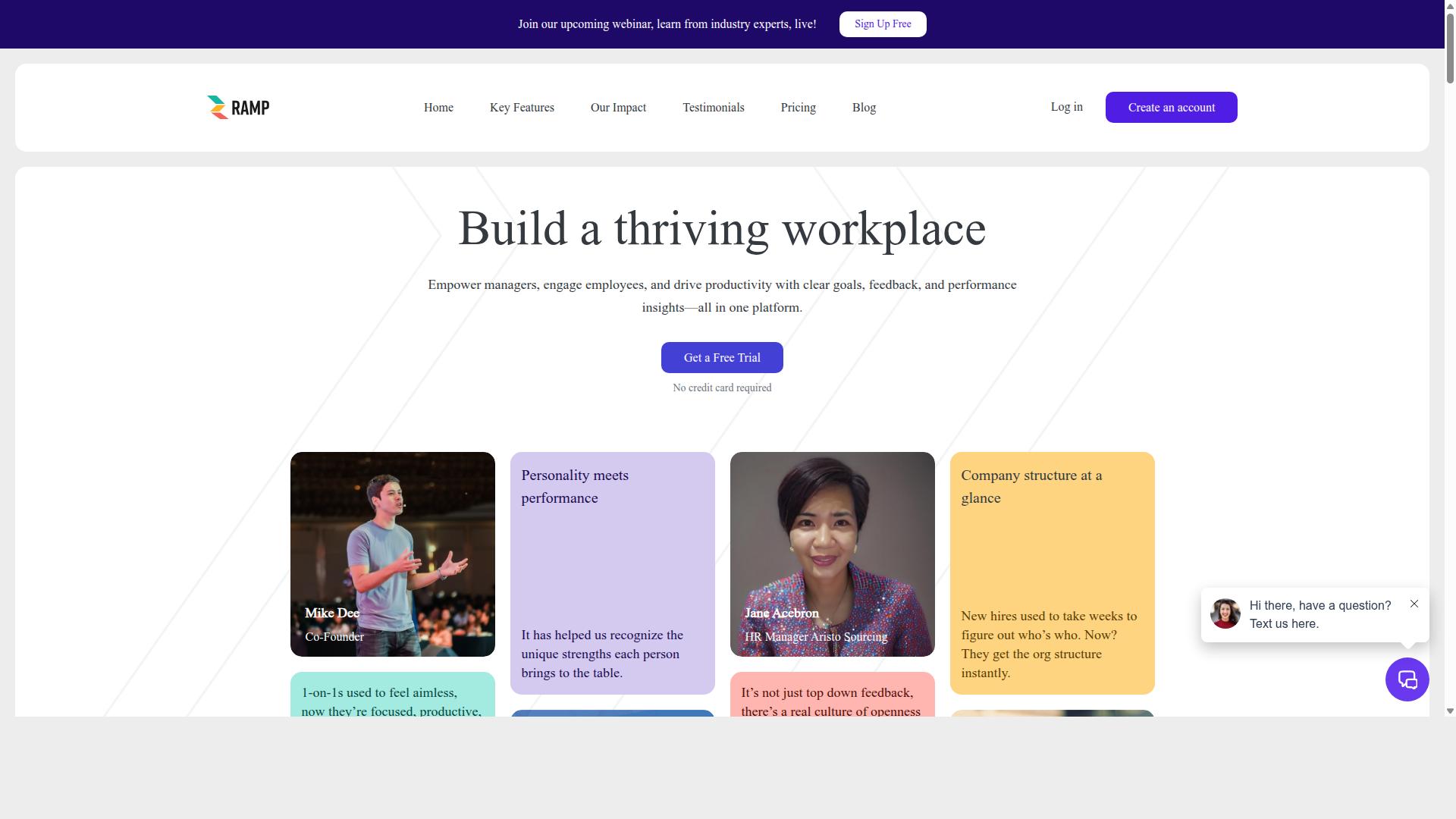
HeyRamp emerges as the best overall alternative by combining performance management, engagement, and communication in one flat-fee platform. It replaces the need to juggle multiple tools for feedback, reviews, and team development. This makes it a strong choice for organizations that want a single source of truth for their people operations.
HeyRamp serves leadership, HR, and individual contributors alike. Leadership gets visibility into team health, while HR gains structured tools for reviews and compliance. Individual contributors benefit from clear 1-on-1 meeting tools and guided conversation templates.
The platform includes company structure visualization, personality insights and testing, and performance review tools. It also offers OKR and goal management with real-time progress visualization. These features work together to support both day-to-day communication and long-term strategic planning.
What sets HeyRamp apart is its breadth. Instead of purchasing separate modules for engagement, feedback, and performance, you get one connected system. This integration reduces friction and helps teams stay aligned on priorities.
All-in-One Engagement and Feedback Platform at a Flat Rate
HeyRamp's flat-rate pricing gives you unlimited access to engagement and feedback tools without per-feature costs. This transparency makes budgeting simple and predictable for organizations of any size. You never have to guess which features are locked behind a higher tier.
The pricing structure is straightforward. Monthly plans cost $5.00 per seat, paid monthly. Yearly plans drop to $3.00 per seat per month, paid annually. Enterprise customers receive custom pricing paid per seat, and a 14-day trial requires no credit card for full access from day one.
This all-inclusive approach covers essential tools like 1-on-1 meeting features with organized agendas and action tracking. It also includes performance reviews, automated reminders, and KPI snapshots. Built-in training videos for 1-on-1s, performance reviews, and personality testing help teams get up to speed quickly.
Compliance documentation is another standout feature. Time-stamped secure records provide automatic documentation for HR processes. This reduces administrative burden while maintaining accurate historical data for reviews and personnel decisions.
Personality insights are integrated directly with performance tools. This connection helps managers understand how individual traits influence work styles and collaboration. The result is a more holistic view of employee development that goes beyond simple metrics.
For organizations comparing Datalligence AI alternatives, this combination of engagement and performance tools at a flat rate is a compelling value. The simplicity of one platform with clear pricing removes the complexity often associated with HR software stacks.
2. Lattice
Lattice is a strong contender for teams that prioritize continuous performance management and employee development. While Datalligence AI focuses on project execution and portfolio oversight, Lattice directs its energy toward the human side of work. It combines performance reviews, goal setting, and engagement surveys into a single platform designed for HR-led organizations.
The platform is particularly well suited for mid-sized to large organizations that need structured review cycles alongside measurable objectives. Lattice pairs performance conversations with OKR tracking, which helps managers connect individual contributions to broader company goals. This dual focus makes it a practical choice for companies that want to align employee growth with business outcomes.
For teams evaluating alternatives to Datalligence AI, Lattice stands out when the primary pain point is talent management rather than task management. It gives HR leaders a clear view of engagement trends and performance patterns over time. The review tools support continuous feedback, while the goal-setting features keep teams anchored to strategic priorities.
That said, Lattice is not built as a dedicated project management or resource allocation tool. Teams that need Gantt charts, sprint planning, or workload management will likely pair Lattice with a separate work execution platform. It works best as a complement to project management software, not a replacement for it.
Lattice has a starting price of $11 per user per month with annual billing, and it holds a G2 rating of 4.7 out of 5. Research suggests it is best for HR-led organizations that want reviews and OKRs in one place. No free plan is mentioned, so budget-conscious teams should factor in the subscription cost when comparing options.
3. Leapsome
Leapsome combines performance management with learning and engagement tools, making it a versatile choice for holistic team development. The platform brings OKRs, reviews, feedback, and learning modules into a single workspace, which reduces the need for multiple disconnected HR tools.
Its 360 degrees review system supports automated review cycles and customizable templates. Teams can run engagement surveys and track goals alongside performance conversations, keeping development and accountability in one place. The platform also includes time tracking and absence management for broader people operations coverage.
Leapsome stands out for its integration capabilities and user-friendly interface. It connects with its own HRIS and offers API access for third-party tools, helping HR teams consolidate their tech stack. The interface is designed for clarity, so managers can navigate reviews, goals, and feedback without extensive training.
For organizations prioritizing continuous improvement, Leapsome provides AI-powered analysis and action plans. These features help leaders spot trends in feedback and engagement data, then act on them systematically. Anonymity filters give employees confidence when sharing candid input during reviews or surveys.
Key highlights include:
- Goals and OKR tracking aligned with performance reviews
- Engagement surveys with AI-driven insights and suggested actions
- Learning and development content within the same platform
- Modular pricing so companies pay only for needed features
Leapsome is ISO 27001:2022 certified and GDPR and CCPA compliant, which matters for teams handling sensitive employee data. It supports 38 languages, making it a practical option for global or remote organizations. Pricing starts at US$3 per user per month, positioning it as an accessible entry point for growing teams.
This platform suits HR leaders who want to reduce tool sprawl while keeping performance, engagement, and learning connected. It works well for companies that treat employee development as an ongoing cycle rather than an annual event. If your team values structured feedback loops and data-backed action plans, Leapsome is a strong Datalligence AI alternative worth evaluating.
4. 15Five
15Five is known for its emphasis on frequent check-ins and employee feedback to drive performance. The platform combines performance management with engagement tools, making it a strong fit for organizations that prioritize continuous conversations over annual reviews. Research suggests that regular feedback loops help employees stay aligned with their goals and feel more connected to their work.
The platform offers a range of products, including tools for reviews, 1-on-1s, and OKRs. It also includes manager-focused products and AI-powered features designed to support coaching and insights. These tools aim to increase employee engagement, performance, and retention, which makes the platform particularly appealing to companies looking to improve manager effectiveness.
One of the standout elements is the focus on manager training and development. By equipping managers with better coaching skills, the platform helps teams maintain consistent communication and address issues before they escalate. This structured approach works well for organizations that value regular, meaningful dialogue between managers and their direct reports.
For teams weighing Datalligence AI alternatives, 15Five is best suited for those who see performance management as a people-first process. It leans less toward project tracking and more toward the human side of work. If your priority is building stronger manager-employee relationships and keeping engagement high, this platform is worth a closer look.
5. Culture Amp
Culture Amp stands out for its powerful analytics and culture-focused approach to employee engagement. It is a people and culture platform designed primarily for mid-market and enterprise teams, typically those with 200 or more employees. Instead of focusing on project execution, this tool centers on understanding how your workforce feels and what drives their performance.
The platform provides employee engagement surveys, pulse surveys, and specialized surveys for DEI initiatives. It also includes onboarding and offboarding questionnaires, giving organizations a clear picture of the employee lifecycle. Beyond gathering feedback, Culture Amp offers benchmarking data so companies can compare their results against industry peers.
For organizations looking to act on feedback, Culture Amp includes performance management tools and continuous feedback features. Teams can run performance reviews, manage goals, and schedule 1-on-1 conversations within the same system. An AI Coach feature offers personalized guidance to employees, helping them improve their performance based on collected data.
This alternative is best suited for HR leaders and people teams who want data-driven insights into company culture. It is less about task automation or project timelines and more about measuring sentiment, tracking engagement trends, and building action plans. If your primary pain point with Datalligence AI is a lack of deep workforce analytics, Culture Amp fills that gap effectively.
Pricing is not publicly listed, and interested teams typically need to request a demo and go through a sales cycle. Research suggests that Culture Amp is a strong choice for organizations that prioritize employee experience and cultural health as a strategic driver of business outcomes.
6. Perdoo
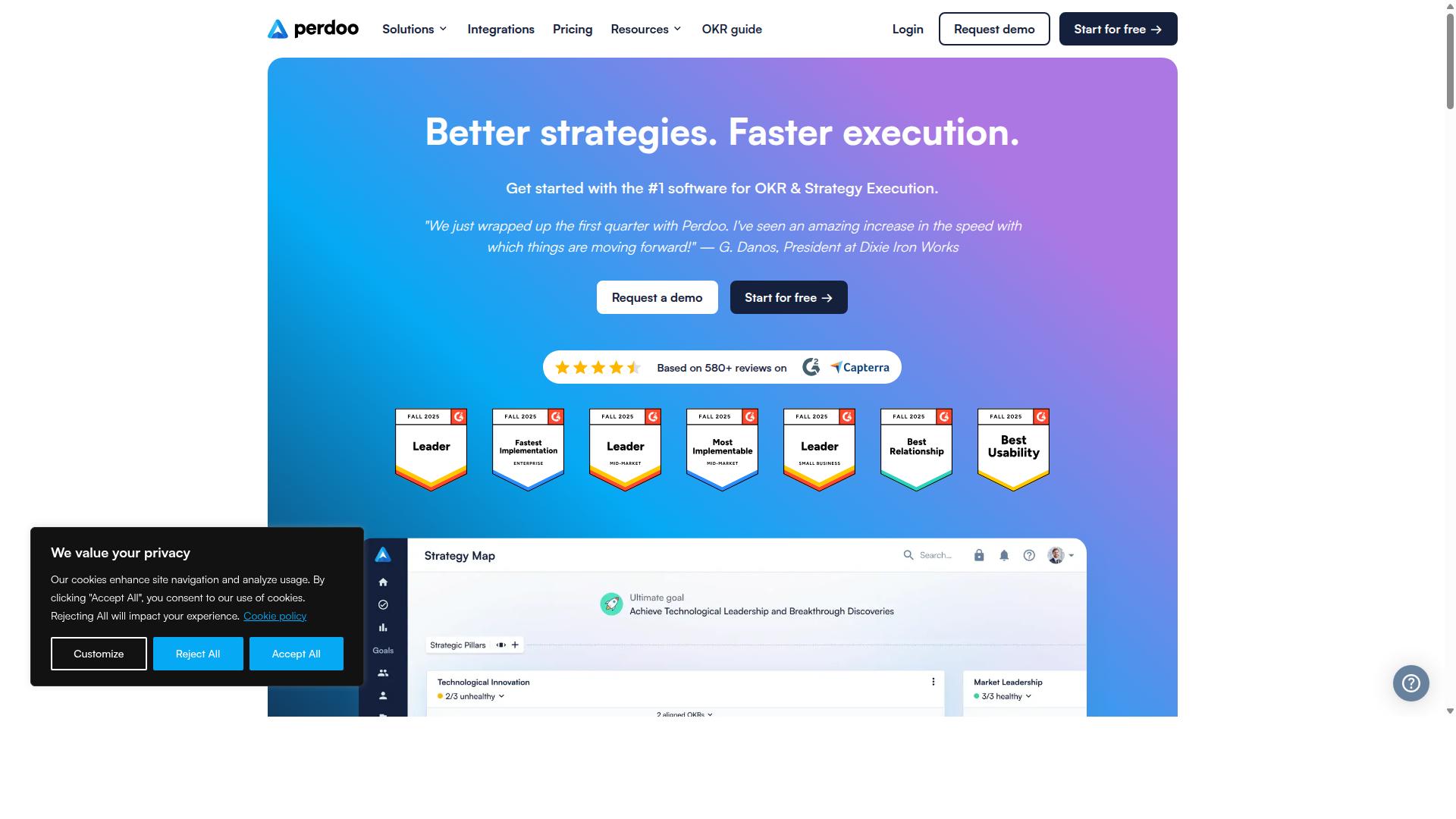
Perdoo specializes in OKR management and strategy execution, ideal for teams focused on goal alignment. The platform connects company direction with team and individual objectives, creating a clear line of sight from leadership down to daily work. This makes it a practical choice for organizations that want more than just task tracking.
Perdoo brings strategy, goals, and performance into one place. Teams can set direction, track KPIs and OKRs, and report on progress without juggling multiple tools. The platform also includes a strategy map and initiative tracking, which helps teams see how their projects connect to broader company priorities.
One of Perdoo's strengths is its focus on simplicity. The interface is designed to make OKR adoption straightforward, which can reduce the learning curve for teams new to this methodology. For companies looking to move away from scattered spreadsheets and email updates, this centralized approach can bring welcome clarity.
However, Perdoo may not suit every organization. Public information suggests paid plans require a minimum of 10 seats, with per-user pricing around EUR8 per month. For smaller teams, that entry point could be restrictive, and costs can add up as headcount grows beyond 30 people.
Perdoo is best suited for companies that have committed to the OKR framework and want a dedicated tool to support it. If your team values goal alignment, regular check-ins, and transparent progress reporting, Perdoo is worth evaluating alongside other alternatives to Datalligence AI.
7. Betterworks
Betterworks offers a comprehensive performance management platform with robust OKR and feedback capabilities. The system is designed to connect individual goals with broader company objectives, which makes it a natural fit for organizations that already embrace the OKR methodology. Many large enterprises appreciate how the platform structures alignment across departments and leadership levels.
The platform includes tools for continuous performance reviews, which replace the traditional annual review cycle with more frequent check-ins. Managers can schedule one-on-ones, document progress, and track development conversations directly within the system. This approach supports a more ongoing dialogue between employees and their leaders rather than relying on a single yearly assessment.
For large organizations, enterprise-grade scalability is a core strength of the Betterworks platform. The system is built to handle complex organizational structures, including multiple business units, global teams, and varying review cycles across regions. Its integration options typically connect with common HRIS and communication tools, which helps reduce friction when rolling out the platform company-wide.
Betterworks focuses heavily on the performance management and talent development side of the workforce. Teams that already use agile methodologies for project work may find that Betterworks complements their existing project management software rather than replacing it. For organizations prioritizing goal alignment and structured feedback loops, this platform offers a credible alternative to Datalligence AI, particularly when performance management is the primary need.
How to Choose the Right Option
Choosing the right alternative depends on your team's size, goals, and budget, here's a framework to guide your decision. Start by listing the pain points you want to solve, whether that is performance management, employee engagement, or goal alignment. Datalligence AI alternatives vary widely, so clarity on your primary use case narrows the field quickly.
Consider who will actually use the tool daily. Options like HeyRamp serve leadership, line managers, human resources, and individual contributors, which makes adoption smoother across an entire organization. If your team includes people at different levels, look for a platform that provides value to each group rather than serving only project managers.
Evaluate the specific features you need most, such as OKR tracking, feedback loops, and analytics. Make a short list of must-have capabilities before you start comparing products. This prevents you from being distracted by flashy extras that your team will never use.
Integration requirements matter more than most buyers expect. Check whether each alternative connects with your existing project management software, communication tools, and data systems. Poor integration capabilities can create data silos that undermine the whole purpose of adopting new software.
Budget is the final major filter, but do not let price alone drive your decision. A cheaper tool that requires constant manual work may cost more in the long run than a slightly pricier option that automates key processes. Consider the total cost of ownership, including training time and ongoing administration.
Use this comparison checklist when evaluating any alternative:
- Does it support your team size, from 5 people to 500?
- Does it cover the features you need, such as OKRs, feedback, or analytics?
- Does it work together with your existing tools and offer API access?
- Does it fit your budget, including setup and training costs?
- Does it work for all your users, from HR to individual contributors?
During demos, ask specific questions rather than accepting general answers. Ask how sprint planning works in practice, how workload management handles resource allocation, and how reporting tools surface data for stakeholder communication. Request a walkthrough of a realistic scenario from your own workflow.
Ask about task automation and time tracking to understand how much manual effort remains. Ask how the tool supports agile methodology or waterfall methodology, depending on your team's approach. Also ask about Gantt charts, Kanban boards, and whether the platform adapts to your preferred way of working.
Finally, involve the people who will use the tool every day. Gather input from line managers, HR, and individual contributors before making a final decision. The best alternative is the one your team actually adopts, not the one with the longest feature list.
Final Verdict
After evaluating the top alternatives, HeyRamp stands out for its all-in-one platform, transparent pricing, and built-in training. While many tools in this space excel at specific functions like Gantt charts or Kanban boards, HeyRamp combines the essential capabilities of performance management, engagement, and people analytics into one unified system. This makes it a strong choice for organizations that want to avoid piecing together multiple software subscriptions.
HeyRamp is trusted by 20+ organizations and 400+ teams, which signals real-world reliability across various industries. Unlike competitors that charge per user or per feature tier, HeyRamp operates on a simple one flat fee pricing model. That transparency makes budgeting predictable, especially for growing teams that would otherwise face escalating costs as they add members.
The platform also addresses a common pain point: adoption. Built-in training and education help managers and employees get comfortable quickly, reducing the need for external consultants. For organizations concerned about audits, the automatic compliance documentation saves significant administrative time. Additionally, personality insights integrated with performance tools give leaders a clearer picture of their teams, while instant coaching tips and automated reminders keep managers on track with their responsibilities.
When choosing between Datalligence AI alternatives, consider your primary needs:
- For all-in-one functionality: HeyRamp covers performance management, feedback tools, and people analytics in one place, making it ideal for small to mid-sized teams.
- For simple pricing: The one flat fee model removes the guesswork that comes with per-seat pricing from tools like Asana, Monday.com, or Jira.
- For team development: The built-in training, guided conversation templates for difficult discussions, and personality insights go beyond typical project management software.
- For compliance-conscious firms: Automatic compliance documentation is a differentiator that most alternatives do not offer as a standard feature.
Other platforms like Microsoft Project, Smartsheet, and Wrike have their strengths, particularly for complex scheduling or enterprise-level reporting. However, they often require additional training investments and separate analytics tools to match what HeyRamp provides out of the box. If your priority is reducing tool sprawl while keeping managers effective, HeyRamp offers a compelling package.
To see whether HeyRamp fits your workflow, the best approach is to test it with your own data. Take advantage of the free trial and explore how the aggregated people analytics dashboards and performance management features handle your real projects. That hands-on experience will tell you more than any feature comparison list. Start your trial today and compare the results against your current project management software. The right choice should simplify your operations, not complicate them.
Recommended Resources: