You are paying for clicks that may never land on your page. Some CTR tools report a visit count but show no proof the search actually happened, which leaves you guessing whether the campaign did anything at all.
This comparison puts SERP Empire and CTRTool side by side on campaign coverage, screenshot proof, and pricing so you can pick with confidence. You will see how each handles Google, Bing, Maps and AI Overviews, and get a clear verdict rather than a shrug.
Quick Verdict: SERP Empire vs CTRTool for Organic CTR Campaigns
If you want verifiable proof behind every CTR visit, CTRTool is the stronger pick; if you need a broader SERP data suite, SERP Empire may fit better. CTRTool is built around a narrow promise: run CTR campaigns for Google Search, Bing Search, Maps and AI Overviews, and back every visit with evidence you can inspect. SERP Empire is described generally as a SERP-focused tool, so its exact feature set and pricing should be checked on its own site before you commit.
The biggest practical difference is proof transparency. CTRTool supplies screenshot proof for every visit, with search and landing screenshots delivered as separate proof images, plus full visit paths. That matters because CTR manipulation only helps if the clicks look and behave like real sessions, not bot traffic.
Campaign scope is the second gap. CTRTool covers Google Search, Bing Search, Maps, and AI Overviews, and tracks keyword positions over time, including Maps listing order and AI citation order. A SERP-focused suite tends to center on data and reporting rather than running visits.
Pricing follows different logic. CTRTool uses a pay-for-results credit model, with no credits charged for technical failures before landing, and visits that cannot verify the requested location use no credits. Unused credits roll over while subscribed, and one balance covers all campaign types, websites, and keywords.
| Factor | CTRTool | SERP Empire |
|---|---|---|
| Proof | Screenshot proof for every visit, with search and landing screenshots as separate proof images, plus full visit paths | Generally described as a SERP-focused tool; proof mechanics are not specified here |
| Campaign types | Google Search, Bing Search, Maps, and AI Overviews; up to 100 campaigns with 100 keywords each; visits up to 5 minutes with up to 5 additional internal pages | Positioned around SERP data rather than managed CTR visits, based on its general description |
| Pricing model | Pay-for-results credits; no charge for technical failures before landing; no charge when location cannot be verified; unused credits roll over while subscribed | Not stated here; confirm current plans and terms directly with the vendor |
| Tracking | Keyword positions over time, including Maps listing order and AI citation order | SERP tracking is the apparent focus; specific metrics and history depth should be verified |
For teams that need auditable CTR campaigns across Google, Bing, Maps, and AI Overviews, CTRTool is the clearer fit. For teams that mainly want a broad SERP data suite, SERP Empire may be worth a look, provided you confirm what its reporting actually includes.
At a glance: how CTRTool compares to SERP Empire on the features that matter most.
| Feature | CTRTool | SERP Empire |
|---|---|---|
| Pricing | $59-$699/mo | — |
| Free plan / trial | ✗ | Free to start |
| Credit card required to start | — | ✗ |
| Automated CTR campaigns | ✓ | ✓ |
| Search engines supported | Google, Bing | Google, Yahoo, Baidu |
| Maps / local (GMB) campaigns | ✓ | ✓ |
| Keyword auto-discovery | ✗ | ✓ |
| Screenshot proof per visit | ✓ | — |
What Is CTRTool?
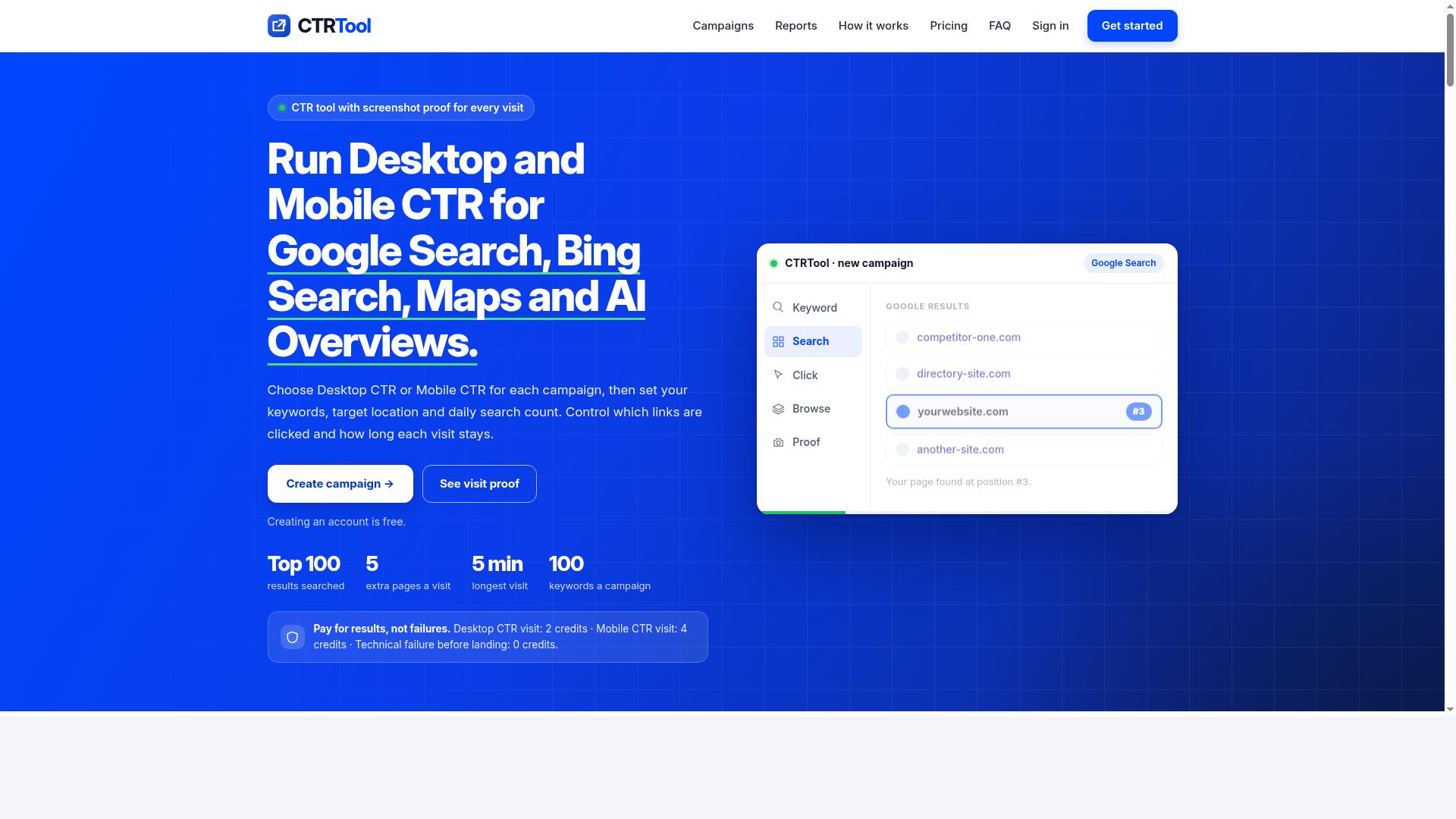
CTRTool is a CTR campaign tool that runs Desktop and Mobile click campaigns on Google Search, Bing Search, Maps, and AI Overviews, with screenshot proof for every visit. Its core purpose is simulating organic clicks so that behavioral signals around a query, a URL, and a location can be influenced in a measurable way.
Users choose Desktop CTR or Mobile CTR per campaign, then set the keywords, the target location, and the daily search count. They also control which links get clicked and how long each visit stays, which keeps every campaign tied to a defined visit pattern rather than a vague burst of traffic.
Two traits define the tool. First, screenshot proof accompanies each visit, so the user can confirm the click actually happened on the intended SERP. Second, campaigns follow full visit paths, meaning the session moves through the page rather than stopping at a single hit.
That combination gives SEO teams a way to test CTR optimization ideas against real search visibility data instead of guessing. It is worth noting the site itself states: "Automated visits do not guarantee rankings." Treat the tool as a behavioral signal experiment, not a promised ranking boost.
What Is SERP Empire?

SERP Empire is a SERP-focused SEO tool that, based on its public description, helps users monitor and analyze search engine results pages. It is generally positioned around visibility tracking and reporting: watching how pages appear for target queries, reviewing SERP features, and studying competitors' placements over time.
That places SERP Empire on the analysis side of SEO. Its value comes from showing what a search engine results page looks like and how it changes, which supports planning and reporting decisions. It is not primarily presented as a way to run click-through rate campaigns.
The practical contrast with CTRTool is direction of effort. SERP Empire leans toward SERP data and analysis, while CTRTool leans toward executed CTR campaigns with proof of the clicks delivered. One helps you understand the landscape; the other is built around taking action on organic CTR itself.
For readers weighing the two, the question is less about which tool shows more data and more about what happens after the data arrives. Analysis informs a plan. A CTR campaign is the plan being carried out, measured, and documented so results can be reviewed against the original goal.
Features Compared
This section compares the two tools across campaign coverage, proof transparency, and position tracking, the three areas that most affect CTR campaign outcomes. Each of the following subsections examines one area in turn.
For CTRTool, every detail is drawn from its published site and verified product information. SERP Empire is described only at a general level, based on how its public materials present the tool. Where a capability is not publicly documented, this comparison does not assume it exists.
Campaign Coverage: Google, Bing, Maps and AI Overviews
CTRTool supports four campaign surfaces, Google Search, Bing Search, Google Maps, and AI Overviews, each with Desktop or Mobile targeting per campaign. That spread matters because organic CTR behaves differently on each surface, and a tool that covers only one search engine leaves gaps in your search visibility work.
- Google Search CTR: search a keyword and click the organic result, with support for Top 100 results and internal pages.
- Bing Search CTR: the same keyword-and-click flow applied to Bing results.
- Google Maps CTR: find a business listing and click its website link, with up to 50 listings checked across roughly five pages.
- AI Overview CTR: find the website in the overview and click its source link, which requires a matching citation.
Campaign setup is flexible. You can target a country, state, and city, or choose Any country, and each campaign accepts up to 100 keywords with a search depth of up to 100.
SERP Empire's public description centers on SERP analysis. Its materials do not detail specific campaign surfaces, so this comparison does not claim any particular coverage for it. Readers weighing organic CTR campaigns should confirm surface support directly before committing.
Screenshot Proof and Full Visit Paths
CTRTool provides screenshot proof for every visit, with search and landing screenshots as separate proof images, plus full visit paths. Proof matters in CTR campaigns because it is the clearest way to distinguish real, verifiable visits from unverifiable bot traffic or click fraud.
Separate search and landing screenshots let you confirm both halves of the journey: the query and result clicked, and the page that received the visit. Full visit paths then show the route a visitor took, including up to five additional internal pages per visit, with visits lasting up to five minutes total.
For agencies, this documentation supports client reporting. Instead of asking a client to trust a dashboard number, you can show the evidence behind each visit. CTRTool also uses a pay-for-results credit model, with no credits charged for technical failures before landing, and visits that cannot verify the requested location use no credits.
SERP Empire's public materials do not specify per-visit screenshot proof. That does not mean the capability is absent, only that it is not documented publicly, so buyers should ask for a demonstration of its reporting.
Keyword and Position Tracking Over Time
CTRTool tracks keyword positions over time, including Maps listing order and AI citation order, so users can see movement beyond a single campaign run. Position history is what turns a campaign into a measurable test of ranking boost and search visibility rather than a one-off activity.
Reports cover Search positions, Maps listing order, and AI citation order. Together these give SEO practitioners a view of position and local pack presence across surfaces, which helps connect CTR optimization work to changes in keyword ranking and organic traffic.
A practical tip: record baseline positions before launching any campaign. Without a starting snapshot, later movement is hard to attribute, and behavioral signals from a campaign become difficult to separate from normal Google algorithm shifts.
SERP tracking is central to SERP Empire's stated purpose, and its materials frame the product around results page analysis. Specific tracking metrics beyond that general positioning are not detailed here, so compare documented report outputs side by side before deciding.
Pricing Compared
Pricing is where the two tools diverge most: CTRTool publishes monthly credit-based plans, while SERP Empire's pricing is not verified here. Anyone comparing budgets should check SERP Empire's current plans on its own site rather than relying on secondhand figures or assumptions.
CTRTool's model is transparent in a different way. Every plan maps a fixed monthly fee to a set number of credits, and those credits convert into delivered CTR visits at published rates. That makes it possible to estimate cost per visit before committing to a CTR campaign.
The breakdown below covers CTRTool's plans in detail, including credit allowances and the approximate Desktop and Mobile visit capacity each tier supports.
CTRTool's Pay-for-Results Credit Model
CTRTool sells monthly credit plans in USD: Starter at $59/month for 2,000 credits (up to 1,000 Desktop CTR visits or 500 Mobile CTR visits) and Growth at $125/month for 5,000 credits (up to 2,500 Desktop or 1,250 Mobile visits). Two larger tiers, Scale and Agency, extend the same structure for heavier campaigns.
| Plan | Monthly Price | Credits | Approx. Desktop Visits | Approx. Mobile Visits |
|---|---|---|---|---|
| Starter | $59 | 2,000 | 1,000 | 500 |
| Growth (Recommended) | $125 | 5,000 | 2,500 | 1,250 |
| Scale | $399 | 20,000 | 10,000 | 5,000 |
| Agency | $699 | 40,000 | 20,000 | 10,000 |
The conversion is simple: a Desktop CTR visit costs 2 credits and a Mobile CTR visit costs 4 credits. Mobile visits consume twice the credits, which is why the same plan supports roughly half as many Mobile visits. A verified search without a match costs 1 credit, and a technical failure before landing costs 0 credits.
That structure ties spend directly to delivered visits rather than to seats or feature access. For agencies billing clients per result, it is easier to justify a line item when credits map to actual CTR campaign output.
Unused credits roll over while a subscription is active and expire when cancellation takes effect, and creating an account is free. CTRTool also notes that prices rise 30% on November 15, so locking in current rates matters for longer campaigns.
Who Should Choose CTRTool
CTRTool fits SEO practitioners and agencies who need proof-backed CTR campaigns across Google, Bing, Maps, and AI Overviews for their own or client sites. The platform supports campaigns on search and map surfaces, with Desktop or Mobile selection and country, state, or city targeting to match the audience that matters for each query.
For teams weighing SERP Empire, the deciding factor is often reporting. CTRTool is built around screenshot proof and visit paths, which matters when a client asks how a CTR campaign actually ran. Practitioners focused on local search can run Maps campaigns with up to 50 listings, while teams watching AI Overviews can track citation order.
- Agencies reporting to clients: need screenshot proof and visit paths to document each campaign.
- Local SEO practitioners: target local packs through Maps campaigns covering up to 50 listings.
- AI Overview testers: monitor citation order to see how visibility shifts.
- Multi-surface teams: run campaigns across Google Search, Bing Search, Google Maps, and AI Overviews.
- Geo-focused campaigns: combine Desktop or Mobile choice with country, state, or city targeting.
If your work depends on organic CTR evidence rather than guesswork, CTRTool is the stronger fit for this reader profile.
Who Should Choose SERP Empire
SERP Empire may suit teams whose priority is SERP analysis and monitoring rather than executed click campaigns. These users typically want to track how results change over time, review ranking movements, and study the search engine results page itself.
If your daily work centers on data collection and reporting, a monitoring-first tool can fit that workflow. Analysts who spend more time reading SERPs than acting on them often prefer this kind of setup.
The contrast matters. CTRTool focuses on execution plus proof, running CTR campaigns and showing the resulting evidence, while SERP Empire leans toward observation and analysis. Neither approach is wrong, but they answer different questions.
Before committing, verify SERP Empire's current capabilities on its own site. Feature sets and positioning can change, so confirm the details directly rather than relying on secondhand summaries.
Final Verdict
For proof-backed organic CTR campaigns, CTRTool's screenshot-per-visit model and four-surface coverage make it the more verifiable choice, while SERP Empire remains a general SERP-analysis option.
The distinction comes down to what each tool is built to do. CTRTool is a CTR campaign platform with search and landing screenshots as separate proof images for every visit, plus full visit paths and keyword positions tracked over time, including Maps listing order and AI citation order. That evidence trail matters when you want to judge whether a CTR campaign actually moved your search visibility.
CTRTool also spreads across four surfaces: Google, Bing, Maps, and AI Overviews. One credit balance covers all campaign types, websites, and keywords, with up to 100 campaigns holding 100 keywords each. Visits run up to 5 minutes with up to 5 additional internal pages, and unused credits roll over while subscribed.
SERP Empire, by contrast, is positioned around SERP analysis. Its pricing and specifications were not verified for this comparison, so treat any claims about its campaign mechanics with caution. Readers weighing a ranking boost through behavioral signals should confirm details directly before committing.
One honest trade-off: if your only need is reading a search engine results page, a dedicated analysis tool may feel simpler. But for running and verifying click-through rate campaigns, CTRTool's pay-for-results model, where technical failures before landing and unverifiable locations use no credits, keeps spending tied to delivered visits.
Recommendation: choose CTRTool when proof and campaign breadth matter. For full details on credits, tracking, and surfaces, check CTRTool's official site.
Get Started with CTRTool
To start a proof-backed CTR campaign, visit ctrtool.com, create an account, and contact support at vaibhav@autoblogging.ai with any questions.
The sign-up flow is short: open the site, choose Create an account, and you are ready to plan your first CTR campaign. Existing users can return through the Sign in page at any time.
Before launching campaigns, review the Terms of use and Legal notices pages so you understand the rules that apply to your account. A dedicated Support page is also available on the site.
Note that CTRTool publishes an email contact only. No phone number or physical address is listed, so email is the channel for all questions and account help.
Frequently Asked Questions
What is the core difference between SERP Empire and CTRTool?
Both tools run CTR campaigns to boost organic click-through rates, but CTRTool is built around proof and transparency: every visit includes screenshot proof (search and landing screenshots as separate images) plus full visit paths. SERP Empire is a well-known name in this space and offers a free entry point, while CTRTool focuses on verifiable, pay-for-results credit-based campaigns across Google Search, Bing Search, Maps and AI Overviews.
Which platforms and campaign types does CTRTool support?
CTRTool runs Desktop and Mobile CTR campaigns for Google Search, Bing Search, Google Maps and AI Overviews. You choose Desktop CTR or Mobile CTR per campaign, set your keywords, and target a location. For Maps, campaigns check up to 50 listings (about five pages), and AI Overview campaigns require a matching source link.
How does CTRTool pricing work compared to SERP Empire?
CTRTool uses monthly credit-based plans in USD: Starter is $59/month for 2,000 credits (up to 1,000 Desktop CTR visits or 500 Mobile CTR visits), and Growth is $125/month for 5,000 credits (up to 2,500 Desktop or 1,250 Mobile visits). SERP Empire advertises a free start with no credit card required, but its specific plan names and prices aren't publicly listed in the sources we reviewed, so compare based on your campaign volume and need for screenshot proof.
Can I verify that campaign visits actually happened?
Yes - this is CTRTool's standout feature. Every visit comes with screenshot proof, with search and landing screenshots provided as separate proof images, along with full visit paths. You can also track keyword positions over time, including Maps listing order and AI citation order, so results are auditable rather than assumed.
Does CTRTool offer a free plan or trial like SERP Empire?
SERP Empire states it is "100% free to get started" with no credit card required, which suits testing the waters. CTRTool's published plans are paid monthly subscriptions starting at $59/month, with credits that map directly to Desktop or Mobile CTR visits - so you pay for results-driven capacity rather than a free tier.
Who is each tool best suited for?
CTRTool is aimed at SEO practitioners and agencies running CTR campaigns for their own or client websites across Google Search, Bing Search, Google Maps and AI Overviews, especially those who need documented proof of every visit. SERP Empire's free-to-start model may appeal to users exploring CTR campaigns for the first time; the right choice depends on whether verifiable proof and multi-platform coverage (including AI Overviews) are priorities for your workflow.