You're evaluating Skynamo for field sales tracking, and the feature set or pricing isn't matching your team's workflow. Many platforms look similar on paper but differ sharply in automation depth, Salesforce integration, and monthly cost per rep. By the end of this article, you'll have a concrete comparison of seven alternatives, a clear breakdown of what to look for in tracking tools, and a definitive #1 pick that balances AI capability with a $65/month price point.
We'll walk through key features for field sales management, pricing and ROI considerations, and then rank each option from Veloxy to Knockio. You'll leave with a decision framework to match your specific sales process, not just a list of software names.
What to Look For in Sales Rep Tracking Tools
When evaluating sales rep tracking tools, prioritize features that directly impact field productivity and manager visibility, such as GPS tracking, route optimization, and seamless CRM integration. The right solution should give your sales team more time in front of customers while providing managers with accurate, real-time data on field activity.
The best tools balance functionality, ease of use, and cost. A feature-rich platform that frustrates your reps will fail, just as a cheap tool lacking essential capabilities will create more problems than it solves. Focus on what your field team actually needs day to day, not on every bell and whistle available.
Key Features for Field Sales Management
Essential features include GPS-based check-in/check-out, geofencing for visit verification, route optimization to minimize travel time, and offline access for remote areas. These capabilities form the backbone of any reliable field sales software and directly impact how efficiently your team operates.
GPS tracking and geofencing ensure reps check in only when on-site, preventing time padding and creating accurate customer visit logs. For example, a geofence around a retail location confirms the rep actually entered the store before the visit is logged, giving managers confidence in the data.
Route optimization reduces drive time between appointments, allowing reps to fit more customer meetings into each day. When combined with territory management and task assignment, managers can plan efficient daily schedules and adjust on the fly when priorities shift.
Sales activity tracking captures calls, emails, and meetings with timestamps, creating a complete picture of rep effort. This data flows into a real-time dashboard where managers can spot trends, identify underperformers, and intervene early. Photo capture with time stamping provides proof of visit for compliance-sensitive industries.
Offline capability matters more than many buyers realize. Field reps frequently work in areas with poor connectivity, and a mobile app that fails without signal renders the entire system useless. Look for tools that sync data automatically once connection is restored.
CRM integration is non-negotiable for most teams. The tracking tool should push visit data, notes, and next steps directly into your customer relationship management system, eliminating duplicate data entry and keeping the sales pipeline current without manual effort.
Pricing and ROI Considerations
Pricing models vary widely, from per-user monthly fees to tiered plans, so calculate total cost of ownership, including setup, training, and possible overage charges, against expected productivity gains. Annual contracts often come with discounts, but month-to-month options offer more flexibility for teams still evaluating their needs.
To estimate ROI, factor in time saved per rep on admin tasks, increased visits per day from better routing, and improved close rates from more consistent follow-up. A simple formula works well: ROI = (savings from time + increased revenue) / total cost. If the payback period stretches beyond a year, the tool may be overpriced for your needs.
Watch for hidden costs beyond the base subscription. Implementation fees, integration work, and per-user overage charges can add up quickly. Some tools charge extra for premium support or additional data storage, so read the fine print before committing.
Most reputable vendors offer free trials, and taking advantage of them is essential. Use the trial period to test the mobile app in real field conditions, check offline performance, and confirm the reporting dashboard meets your needs. A hands-on evaluation beats any sales demo when assessing whether the tool genuinely improves sales rep productivity.
1. Veloxy - Best Overall
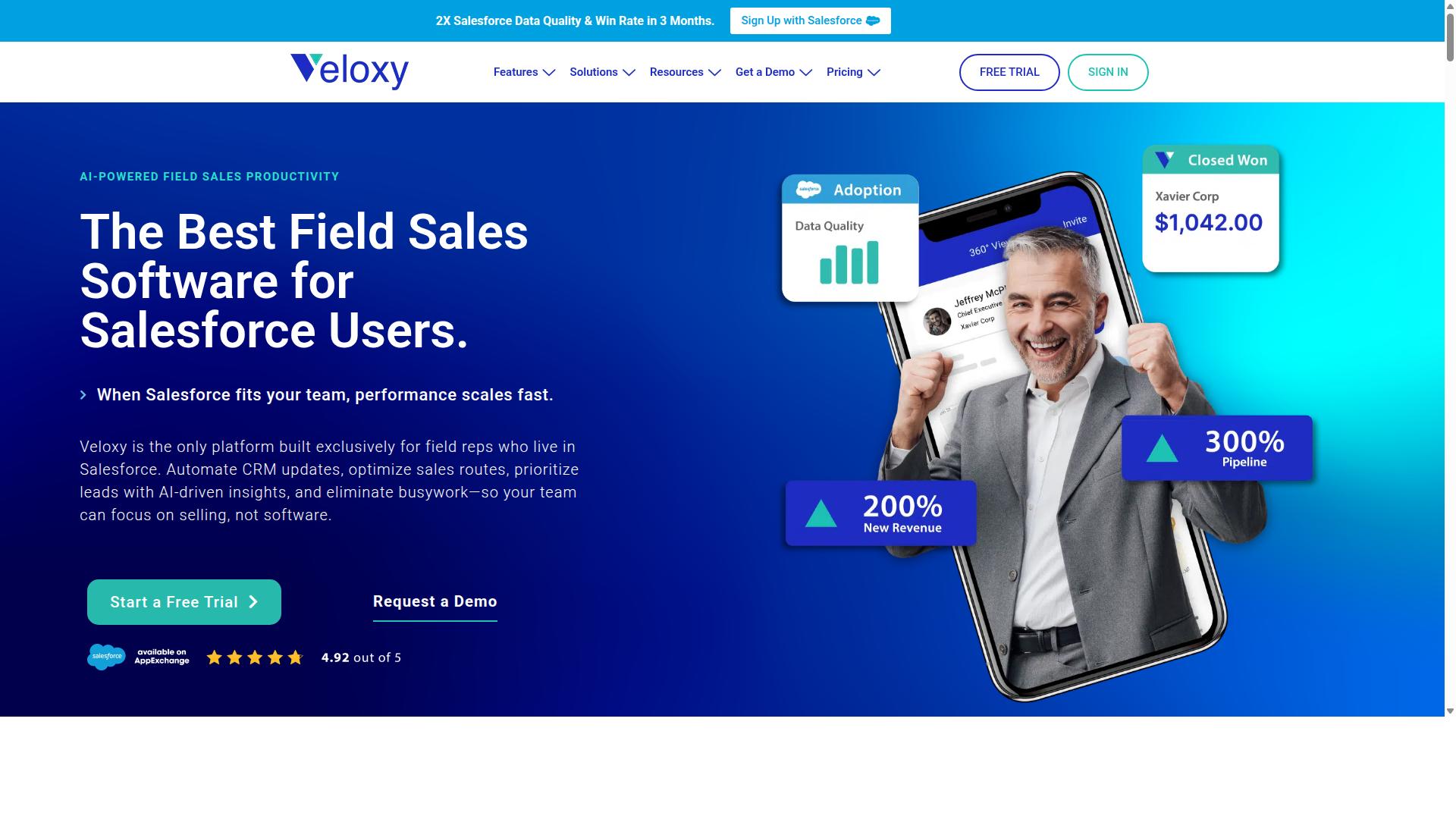
Veloxy stands out as the best overall sales rep tracking solution, offering AI-powered features natively integrated with Salesforce to double sales productivity within three months. Unlike generic field sales tools, Veloxy is the only platform built exclusively for field reps who live in Salesforce.
This specialization means every tracking feature works directly inside the CRM your team already uses. No extra logins, no manual syncing, and no lost data between systems. For sales teams comparing Skynamo alternatives, this native approach removes friction while adding powerful automation.
AI-Powered Salesforce Native Tracking
Veloxy's AI assistant automatically logs customer interactions and captures visit data, all within the Salesforce interface. The AI automates data entry, saving over an hour per day for each salesperson.
Key tracking capabilities include:
- AI-driven automatic logging of calls, emails, and visits into Salesforce
- GPS and geofencing for check-in and check-out with photo capture and time stamping
- Route optimization using AI to maximize daily customer visits
- Real-time dashboard for managers to monitor rep locations and productivity
- Offline access for remote work in areas with poor connectivity
Because Veloxy is built natively for Salesforce, CRM integration is seamless. Your customer visit logs, sales activity tracking, and territory management data flow directly into your existing pipeline. The full-featured app includes Salesforce Automation, Buying Signals, Lead Qualification, Pipeline Management, Sales Analytics, and a Quick Dialer.
The mobile app works on iPhone and Android, while the web app runs from any browser. Sales reps spend 90 to 95% of their time on activities that produce sales with Veloxy. Before adopting the platform, that number was only 30 to 35%.
Pricing and Value at $65/Month
At $65 per user per month, Veloxy offers a competitive price point that includes a 14-day free trial and discounts for annual or multi-year commitments. Teams save 25% with an annual subscription and 50% with a three-year commitment, bringing the cost to less than $2 per day.
The price includes the full-featured field sales app with all AI capabilities. There are no tiered plans that hide essential tracking features behind premium pricing. For teams of 25, a company plan is available at $899 per month with 45% savings on annual billing.
Consider the ROI math. If the AI automation saves 60 minutes per rep daily, that time translates directly into more customer visits and pipeline activity. Veloxy guarantees that field sales reps pay off their annual license in one to two months. If you don't get ROI in three months, you get three months free.
Compared to other Skynamo alternatives, Veloxy delivers enterprise-grade AI features at a mid-market price point. Review sites back this value: G2 rates Veloxy 4.86 for enterprise, 4.71 for mid-market, and 4.76 for small business. The platform holds 190+ reviews on Capterra and 200+ on Salesforce AppExchange.
2. SPOTIO
SPOTIO is a dedicated field sales tracking app known for its user-friendly interface and robust GPS-based visit logging, making it a solid choice for teams prioritizing simplicity. The platform is designed for reps who work out in the field, particularly those handling door-to-door sales or route-heavy outside B2B accounts.
Its core feature set centers on GPS tracking and route planning, which helps sales teams organize daily visits efficiently. Reps can use territory and pin mapping to visualize their coverage areas, while the mobile-first design ensures that check-in and check-out actions happen quickly without friction. The app also includes lead management tools and activity reporting, giving managers visibility into what happens after each customer visit.
SPOTIO integrates with popular CRMs like Salesforce and HubSpot, which makes it easier for teams to keep customer relationship management data in sync without manual entry. This integration supports sales activity tracking across the pipeline, so managers can see how field efforts translate into pipeline movement.
Pros and cons worth noting:
- Pros: Ease of use is a standout, with a dedicated mobile app that reps can learn quickly. The straightforward approach to visit management and photo capture with time stamping works well for teams that need reliable data collection.
- Cons: SPOTIO offers limited AI capabilities compared to more advanced field sales software. Pricing may be higher for advanced features, and the starting price is around $39 per user per month, which can add up for larger teams.
For small to mid-sized teams that need straightforward tracking without complex AI, SPOTIO is a practical alternative to Skynamo. It excels at the fundamentals of sales rep tracking and territory management, though teams seeking deeper automation or predictive insights may find the platform less flexible. Its G2 rating of 4.5 reflects solid user satisfaction, particularly among route-based sales organizations.
3. SalesRabbit
SalesRabbit focuses on door-to-door and field sales with features like canvas mapping, territory management, and lead routing, appealing to teams that need rapid territory coverage. The platform is built around a mobile-first design, so reps can manage their day directly from a smartphone while moving between locations.
For sales rep tracking, SalesRabbit gives managers visibility into where reps are canvassing and which leads they have touched. Its territory mapping tools help teams divide neighborhoods and assign specific zones, while lead distribution ensures that new prospects flow to the right rep without manual sorting.
Gamification is a notable strength here. Leaderboards, badges, and daily goals can boost rep motivation in high-volume outdoor sales environments. Teams that thrive on friendly competition often see consistent engagement from these built-in incentives.
SalesRabbit also integrates with common customer relationship management platforms, which helps sync lead data and activity logs. However, the tool is less robust for inside sales or teams that need complex analytics. Reporting tends to stay focused on field metrics rather than deep pipeline analysis or multi-stage forecasting.
Pricing is straightforward for smaller teams. The Team plan runs at $59 USD per user per month, while the Pro plan costs $75 USD per user per month on monthly billing or $49 USD per user per month billed annually. Enterprise pricing is custom, and add-ons like DataGrid AI, Mover Leads, and Digital Contracts are available at additional costs.
SalesRabbit suits industries such as roofing, solar, telecom, and home services. Teams with specific door-to-door needs will find it a viable option, though organizations focused on broader sales rep tracking across mixed channels may want to evaluate how its field-centric features align with their workflow.
4. SimplyDepo
SimplyDepo offers a lightweight field sales app with essential tracking features, including visit scheduling and photo evidence, at an affordable price point for small teams. It is designed as an all-in-one mobile platform for CPG brands, distributors, and merchandisers to simplify B2B field sales, retail execution, and route planning.
The platform focuses on practical visit management tools. Sales reps can perform check-in and check-out at customer locations, capture photos as proof of service, and record store audit notes directly on their mobile devices. These features help managers maintain accurate customer visit logs without requiring reps to carry extra paperwork.
Key capabilities include:
- Mobile order entry with real-time product and pricing access
- Offline support for areas with poor connectivity
- Route planning with integrated maps
- Shelf data capture and photo documentation
- CRM-style customer tracking
- Real-time dashboards for manager oversight
The simplicity of SimplyDepo is its main appeal for small businesses with basic tracking needs. Teams that need straightforward sales activity tracking and check-in functionality will find the learning curve manageable. The mobile app is built for field reps who want to record visits quickly and move to the next stop without complex data entry.
However, potential drawbacks exist for growing organizations. Limited integrations may frustrate teams that rely on a broader tech stack, though the platform does offer connections with QuickBooks, Zapier, and an open API. Scalability questions also arise for larger sales teams that need advanced territory management or deep analytics beyond the core reporting dashboard.
For companies evaluating alternatives to Skynamo, SimplyDepo works best when the focus is on essential visit management and order capture rather than sophisticated sales pipeline automation. Teams with straightforward requirements will appreciate the ease of use, while those anticipating rapid growth should consider whether the feature set will keep pace with their expanding needs.
5. Map My Customers
Map My Customers excels in route optimization and territory visualization, turning your customer database into an interactive map that simplifies daily planning. This field sales platform is purpose-built for B2B outside sales teams, making it a practical choice for organizations that rely heavily on face-to-face meetings.
The platform offers native two-way CRM sync with popular systems like Salesforce, HubSpot, Zoho, and Dynamics. This means your customer visit logs and sales activity tracking stay current without manual data entry, which helps reduce administrative busywork for reps in the field.
Map My Customers provides several notable features for sales rep tracking and management:
- Smart Planner for automated scheduling and task assignment based on location
- AI Field Agent to assist reps with data capture and next-best actions
- Exec HQ for manager oversight and reporting dashboards
- Territory management tools that help balance workload across your team
On the positive side, the intuitive map interface is a major strength. Reps can see their entire day at a glance, and the route planning functionality helps minimize drive time between appointments. The mobile app is designed for on-the-go use, supporting offline access so reps can still view customer data and log visits without a stable connection.
However, there are some limitations to consider. While the platform includes AI-driven features, the core experience is still centered on mapping and routing rather than deep automation or advanced workflow capabilities. Teams looking for extensive sales pipeline automation or complex order management might find the scope narrower than expected.
Starting at $60 per user per month, Map My Customers positions itself as a mid-tier option for field sales teams. It holds a solid G2 rating of 4.5 out of 5, which suggests consistent user satisfaction. For sales managers who prioritize route optimization and territory visualization above all else, this tool remains a credible alternative to Skynamo for sales rep tracking.
6. Mapsly
Mapsly is a map-based sales tracking tool that syncs with your CRM to provide real-time route optimization and territory analytics, ideal for teams that rely on visual data. The platform focuses on making complex field operations easier to plan, especially for organizations managing multiple reps across large geographic areas. One of Mapsly's standout strengths is its multi-rep routing engine. It can optimize routes for an entire team in a single run, handling thousands of stops across multi-day schedules. This is particularly valuable for field sales teams that need to coordinate several reps visiting different customers on the same day without overlapping or wasting drive time. The platform integrates with 15 or more CRM systems, with Salesforce being a primary focus. Data syncs in real time, so updates made in the field appear in your CRM almost immediately. Mapsly also offers offline maps and offline access to CRM data on both iOS and Android devices. Reps can continue working in areas with poor connectivity and sync their check-ins, route progress, and collected data once they are back online. Territory management is another area where Mapsly shows considerable depth. Users can draw territories directly on the map or import existing boundaries from external files, and this works on a worldwide scale. Managers can assign reps to specific regions and visualize coverage gaps at a glance. The analytics suite includes more than 40 chart types and SQL-based reporting, which gives teams the flexibility to build custom dashboards around sales activity tracking and route efficiency. When evaluating Mapsly as a Skynamo alternative, consider these factors:- Strong map visualization for route planning and territory analysis
- Real-time location tracking with offline capability for remote areas
- Customizable maps and automation rules for repetitive workflows
- No seat minimum and a free trial of the full platform
7. Knockio
Knockio is a newer entrant in the field sales tracking space, offering automated check-ins and lead management with a focus on simplicity and integration with major CRMs. The platform combines door-to-door canvassing software with a field service CRM, making it a versatile option for outside sales teams that need both tracking and operational tools in one place.
Core features include GPS check-in, lead capture, and sales activity tracking that automatically log customer visits. Knockio also connects with popular CRMs like Salesforce and HubSpot, which helps keep customer relationship management data in sync without manual entry. The interface is designed for ease of use, so reps can spend less time on data collection and more time on customer engagement.
Beyond basic tracking, the platform covers the full job lifecycle with tools for estimates, invoicing, work orders, appointments, and payment processing. It also offers territory management, sales pipeline visibility, and reporting dashboards for manager oversight. These extras make it useful for industries like fiber internet, home security, HVAC, roofing, and solar, where field service and sales often overlap.
Pros of Knockio include its easy setup and automated logs, which reduce the administrative burden on sales reps. The built-in automations and workflow tools help streamline repetitive tasks, and the mobile app supports offline access for reps working in remote areas. For teams that need a simple way to manage check-in/check-out and customer visit logs, this tool covers the essentials well.
On the downside, Knockio may lack advanced features like AI-driven insights or complex analytics that larger enterprises expect from field sales software. Some teams looking for deep route optimization or sophisticated sales performance modeling might find the current reporting options limited. The company has hinted at AI Receptionist, AI Chatbot, and Lead Generation features coming soon, but these are not yet available.
Pricing is not publicly disclosed, so interested buyers should request a quote to see if it fits their budget. Overall, Knockio works best for small to mid-sized field sales teams that prioritize simplicity, CRM integration, and an all-in-one approach over heavy customization or advanced analytics.
How to Choose the Right Option
Choosing the right sales rep tracking tool depends on your team's size, CRM ecosystem, and whether you need advanced AI or just essential visit logging. The best place to start is with your existing tech stack. If your team runs on Salesforce, a Salesforce-native option will feel far more natural than a generic tool that requires constant syncing.
Begin by listing your must-have features and ranking them by importance. A simple checklist can save you weeks of trial and error. Consider these core factors before you compare any alternatives to Skynamo:
- CRM compatibility: Is the tool native to your CRM or does it rely on third-party integrations? Native tools reduce data errors.
- Feature complexity vs. ease of use: Does your team need advanced route optimization or just simple check-in/check-out? More features can mean more friction.
- Team size and budget: Per-seat pricing adds up quickly for larger field sales teams. Calculate total cost, not just the base plan.
- AI automation vs. manual logging: Decide whether you want automated data capture or if reps will manually enter customer visit logs.
- Offline access: Field reps often work in areas with poor connectivity. Confirm the mobile app functions without a signal.
- Scalability: Will the tool still work when you grow from 10 reps to 100? Check how easily you can add users and territories.
Once you have your checklist, run a pilot with your most active field reps. Their feedback matters more than any feature list. A tool that looks powerful in a demo can feel clunky after a week of real-world use.
Keep in mind that the goal is to enhance sales rep productivity, not to add administrative overhead. The right solution should reduce manual work, capture accurate GPS tracking, and give managers better oversight without constant follow-up. For example, Veloxy is designed specifically for sales reps and managers using Salesforce CRM, making it a strong fit for teams already invested in that ecosystem. Other tools may suit teams on different CRMs or with simpler needs.
Finally, schedule a trial with two or three finalists. Test real-world scenarios like photo capture, time stamping, and territory management. The tool that aligns with your sales process and feels intuitive to your reps is the one worth keeping.
Final Verdict
For most field sales teams using Salesforce, Veloxy delivers the most comprehensive tracking and AI-powered automation, making it our top recommendation. The platform is built exclusively for field reps who live in Salesforce, which means it fits into existing workflows instead of forcing a new system. Other tools on this list handle GPS tracking, visit management, and reporting well, but few combine those features with the depth of native CRM integration that Veloxy offers.
Veloxy stands out because of its AI automation and measurable results. After three months, Veloxy customers double their sales productivity, double pipeline and revenue, and pay for their annual Salesforce subscription. Those are concrete outcomes, not vague promises. The shift in focus is dramatic too. Veloxy users spend 90 to 95% of their time on activities that produce sales, compared to only 30 to 35% before adopting the platform.
For managers, the value shows up in oversight and efficiency. Sales rep tracking becomes automatic, visit logs update in real time, and reporting dashboards give clear visibility into territory coverage and customer engagement. The platform is recognized by G2 as the Highest Performer, with enterprise reviews at 4.86, mid-market reviews at 4.71, and small business reviews at 4.76. Capterra shows 190+ reviews and Salesforce AppExchange shows 200+ reviews, all reinforcing the same conclusion.
Other alternatives remain viable for specific needs. Some tools excel at route optimization, others focus heavily on geofencing or offline access. If your team uses a different CRM or needs a lightweight standalone app, those options may serve you well. But for Salesforce-centric field teams, Veloxy offers the best combination of features, value, and ROI. The company guarantees that no other field sales app on the market offers as many critical features at this price.
If you are evaluating Skynamo alternatives, start with Veloxy. Try the 14-day free trial and see how the AI-powered automation changes your team's daily rhythm. For questions about implementation or how Veloxy fits your specific sales workflow, reach out to the team directly. They also offer a free resource, Samir's Big Blue Book of Field Sales, which is a practical guide for improving field sales performance.
Recommended Resources: